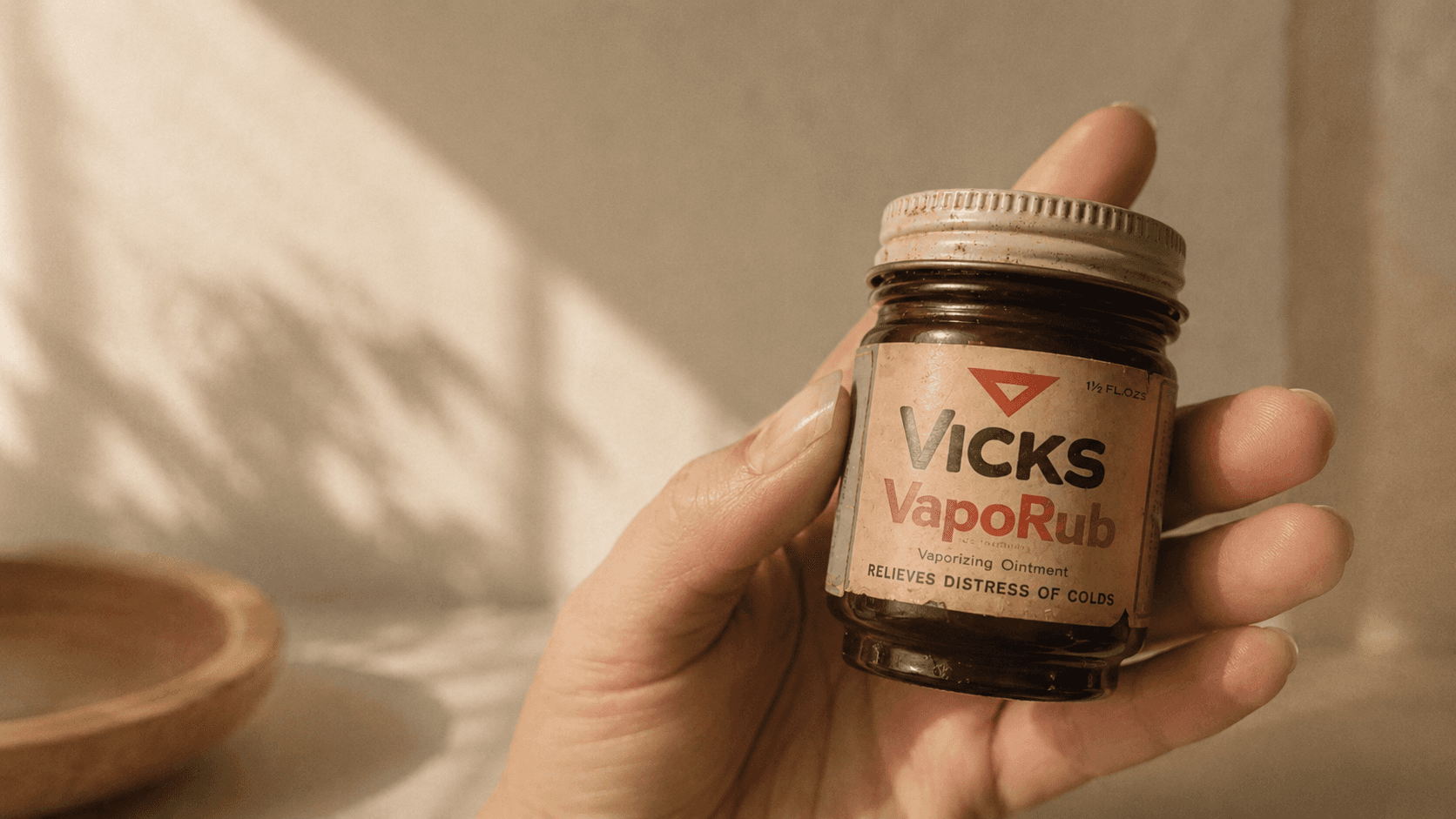
If you spend ten minutes on Reddit researching toenail problems, you'll see the same recommendation come up over and over. Just rub Vicks VapoRub on it.
The advice is offered with a kind of half-shrug. Like everyone knows it's strange. Like nobody quite believes it should work. Like there's something almost embarrassing about a chest rub being the answer.
Here's the honest version, before we get into the research.
We used Vicks. It works. It's also messy, smelly, and inconvenient enough that most people don't keep doing it long enough to see results.
That's the whole post in one paragraph. Below is the long version, with the research, the ingredient breakdown, and an honest read on when it's the right answer and when it isn't.
01Why this question gets asked so often.
Vicks VapoRub for toenails is one of those folk remedies that won't go away because, unlike most folk remedies, it kind of works. People keep recommending it because they keep watching it produce results, especially on milder, slow-progressing nail issues.
For decades, that was the entire evidence base. Anecdotal. A grandmother told a daughter. A daughter told a friend. The friend tried it on the recommendation alone and watched it work.
Then in 2011, researchers at Michigan State University ran an actual clinical study.1 Small. 18 participants. But peer-reviewed and published in the Journal of the American Board of Family Medicine.
The only peer-reviewed study on Vicks for toenails. In four numbers.
Derry et al, Michigan State University. 18 participants applied Vicks VapoRub once daily to affected toenails for 48 weeks. The findings, summarized.
Complete cure
Five out of 18 participants saw mycological cure plus visible nail clearing. For comparison, terbinafine pills sit at 23% complete cure on the big toenail.
Partial improvement
Ten of 18 participants saw measurable but incomplete improvement in appearance. Plus the 27.8% with complete cure means 83% saw some kind of result.
Treatment duration
Weeks of daily application required to see the results above. Roughly the same timeline as a course of prescription antifungals plus nail grow-out.
Side effects reported
No bloodwork. No drug interactions. No liver function monitoring. This is the strongest argument for Vicks: the safety profile.
Source: Derry CW, Snyder ER. Topical treatment with Vicks VapoRub for onychomycosis. Journal of the American Board of Family Medicine, 2011.
The study has caveats worth naming. 18 participants is a small sample. There was no placebo control. The fungal species in the participant pool varied (the researchers identified at least 17 different species), which makes the results harder to generalize. The complete-cure result is still the strongest peer-reviewed evidence ever published for any over-the-counter topical on toenail fungus.2
A 27.8% complete cure rate from a chest rub is, statistically, in the same neighborhood as a 12-week course of prescription oral antifungals.
02What's actually in the jar.
Vicks VapoRub is one of the older formulations still on US shelves, registered with the FDA as an over-the-counter drug for cough suppression. It was never developed for toenails. Its activity on nails is, in regulatory terms, an off-label use.
What's interesting is that the four active ingredients in Vicks happen to include several with documented antifungal activity in published literature.
Why a chest rub does anything for nails.
The four active ingredients in Vicks VapoRub, with the documented antifungal activity of each. The reason a folk remedy turned out to have research behind it.
Camphor
Documented antifungal activity in laboratory studies. The active most likely doing the work on the nail.
Menthol
Antifungal and antimicrobial activity in vitro. Camphor's natural pairing in the medicine-cabinet tradition.
Eucalyptus oil
Documented antimicrobial properties. Likely contributing to the overall effect, not the lead actor.
Thymol
Naturally derived from thyme oil. Documented broad antifungal activity. The strongest individual antifungal in the mix.
Sources: Vicks VapoRub Drug Facts label; multiple in vitro studies on camphor, menthol, eucalyptol, and thymol against dermatophyte fungi.
The base of the jar is petroleum jelly. That's the inactive ingredient that makes Vicks Vicks, but it's also where most of the practical complaints come from. Petroleum jelly stains. It coats. It makes a mess.
The actives are the interesting part. Camphor and menthol have been used together in medicine-cabinet preparations since the late 1800s. Their combined antifungal activity wasn't formally studied for nails until the 2011 Michigan State paper, but the chemistry was always there. Vicks happened to be the most widely available consumer formulation that contained them.
Vicks works because the medicine cabinet was already half-right. Camphor, menthol, and thymol were antifungal. They just weren't built for nails.
complete cure rate. From a chest rub.
When Vicks is reasonable. When it isn't.
The honest version isn't "Vicks always works" or "Vicks doesn't work." It's that Vicks is a reasonable starting point for a specific kind of situation, and a heavier-than-needed answer for others.
Below is roughly how to think about it.
When Vicks is worth trying. When it isn't.
A simplified guide based on the published research and what we've actually seen in customers who tried Vicks before Veto.
Vicks is reasonable if
- Mild, single-toe involvement. Some discoloration, no thickening, not progressing.
- You're cost-conscious. A jar of Vicks is roughly five dollars and lasts months.
- You're willing to apply it daily for close to a year. The 2011 study was 48 weeks.
- You're not bothered by the smell, the staining, or the greasy texture.
- You want to avoid prescription medication for a cosmetic concern.
- Nothing about the nail is painful or progressing rapidly.
Vicks is the wrong answer if
- The nail is painful, thickening rapidly, or spreading to other toes.
- You have diabetes or compromised circulation. Toenail issues need medical attention for you.
- You can't tolerate the smell or the mess. Daily application matters; intermittent doesn't work.
- You've already tried Vicks for three months with no visible change at the cuticle.
- You're looking for something to keep on the bathroom counter that doesn't ruin sheets.
- Your concern is cosmetic appearance more than fungal infection itself.
A thinking tool, not medical advice. Persistent or worsening nail issues warrant a podiatrist visit.
Most people who try Vicks fall into one of two camps. The ones who stick with it for 48 weeks tend to see results that match the research. The ones who quit at week six because of the smell, the staining, or because nothing visible has changed yet end up concluding it doesn't work, and the conclusion isn't really fair to the chemistry.
The actual problem with Vicks isn't the actives. The actives have research behind them. The problem is the petroleum jelly base and what it does to your evening, your sheets, and your relationship with the bottle on your nightstand.
04What Vicks doesn't do. The honest limits.
Four things, in order of how often we hear them. These aren't reasons not to try Vicks. They're the reasons most people who try it don't keep doing it.
The smell. Camphor and menthol are volatile. They evaporate into the air in your bedroom for hours after you apply. Some people describe it as nostalgic, some describe it as overpowering. If you live with someone, they get an opinion. The Reddit corpus is full of "my wife threatened to make me sleep in the spare room."
The stains. Petroleum jelly transfers onto sheets, socks, and the inside of shoes. The stain is hard to wash out completely. Most Vicks users end up with a designated old pair of socks and a towel they put under their feet at night.
The discomfort. The volatile actives produce a noticeable cooling and warming sensation on the skin. Pleasant on a chest. Less pleasant on a toe under a sock at 11pm.
The inconvenience. A jar of Vicks doesn't apply itself elegantly to a small target like a toenail. It takes a finger, a cotton swab, or a careful scoop. It's hard to do quickly. It's easy to put off. After three months of doing it every night, most people stop. The 48-week timeline the research depends on is the part most people don't make it through.
Vicks works. It also asks more of your evening, your sheets, and your patience than most people want to give a folk remedy.
05Where Veto fits.
We've been there. Two decades cycling through drugstore picks, home remedies, prescriptions, and even considered surgery. Some worked partially. None held. Vicks worked partially too. The chemistry made sense to us long before we read the 2011 paper.
So we made the routine we needed. The bottle that lives on your counter. The brush-on that doesn't stain the sheets. Camphor and menthol from the same medicine-cabinet tradition Vicks comes from, paired with undecylenic acid (the pharmacy ingredient that's been in topical antifungals since the 1940s) and conditioning oils that improve the appearance of the visible nail.
Veto isn't a substitute for what Vicks does. It's not even in the same regulatory category. Vicks is registered as an OTC drug. Veto is a cosmetic. The conditioning oils improve and maintain the appearance of damaged toenails. We can't claim Veto treats fungal infection. We're not a drug.
What Veto does well is the daily routine. The thing you can keep doing every night for six to twelve months because it's small enough to actually keep doing. No greasy sheets. No smell that fills the bedroom. No fingernail-sized scoop on the edge of a jar.
Vicks works for the people who can put up with what it asks of them. Most can't. If you tried it and the smell, the stains, or the bottle on your nightstand wore you down, that's why we created Veto.
06The honest takeaway.
Vicks VapoRub on toenails is the rare folk remedy where the chemistry was right all along. The 2011 study put numbers on what generations had been observing anecdotally. A 27.8% complete cure rate from a $5 jar of chest rub is genuinely impressive, and it's a reasonable starting point for a lot of people.
If your situation is mild, you're cost-conscious, and you're willing to put up with what Vicks asks of your evening for a year, it's a reasonable starting point. Most people aren't willing to put up with it that long. That's the bigger problem with Vicks than the chemistry.
If you've tried Vicks and quit because the practical reality wore you down, that's not a failure of the chemistry. That's a failure of the format. The actives work. The jar didn't.
Either way, the medicine cabinet had a real answer hiding in it. The 2011 study just put the numbers next to the wisdom. We took the same chemistry, paired it with a pharmacy ingredient that's been around since the 1940s, and put it in a bottle that lives on the counter without ruining the rest of the bathroom.
If the smell and the goop got the better of you, we created Veto for that exact reason. Same chemistry family. None of the mess.
*Veto is a cosmetic and is not a treatment for any medical condition.
References
- Derry CW, Snyder ER, Khoury MY, Hilbelink DR, Hertenstein HE. Topical treatment with Vicks VapoRub for onychomycosis. Journal of the American Board of Family Medicine, 2011; 24(1): 69-74. 18 participants, 48-week treatment course, 27.8% complete cure (mycological + clinical), 55.6% partial improvement.
- Vicks VapoRub Drug Facts label. Active ingredients: camphor 4.8%, menthol 2.6%, eucalyptus oil 1.2%. (Note: thymol is present in some Vicks formulations as part of the inactive ingredients in the petroleum jelly base, though concentrations vary by region.)
- Multiple in vitro studies on the antifungal activity of camphor, menthol, eucalyptol, and thymol against common dermatophyte species. Journal of Essential Oil Research and others.
- Shemer A, Sakka N, Trau H. Clinical comparison and complete cure rates of terbinafine efficacy in affected onychomycotic toenails. Journal of the European Academy of Dermatology and Venereology, 2015. Big toenail complete cure rate from oral terbinafine: 23%.
- Reddit thread analysis. Customer feedback on Vicks VapoRub for toenails consistently identifies smell, staining, discomfort, and inconvenience as the four most frequent reasons for discontinuing the protocol before completing the recommended treatment duration.