Search Reddit for "toenail fungus" and you'll find dozens of long, devoted posts from people who finally fixed their nails after years of trying. They share the products, the timelines, the photos.
And almost every one of those posts has the same comment underneath, asked over and over by different people:
"Can you share your exact routine? Did you do it twice a day? Did you do it all at once? What order? A detailed guide would be amazing."
The advice is everywhere. The products are everywhere. The sequence is missing.
Most people improvise their toenail routine because nobody ever wrote them a real one. Here's a real one.
01Why a routine matters more than the product.
Toenails are slow. They grow about 1 millimeter a month. The visible nail you have today was already there three months ago. Whatever you do tonight will not show up at the cuticle until well into the second month.
This timeline rewards consistency more than it rewards intensity. Doing one thing every night for six months will produce more visible change than doing five things every night for six weeks.
The reason most people don't see results from products that should work is not because the products fail. It's because the routine fails. Between week 3 and month 2, the visible nail still looks the same, the bottle moves from the bathroom counter to the bathroom drawer, and the routine quietly ends.
A boring routine you can keep is worth more than an ambitious routine you can't.
02The five-step nightly routine.
Below is the version of a nightly toenail routine that most podiatrists would describe if they had time, and that the most successful Reddit threads independently arrive at.
It is not complicated. It takes about three minutes. The skill is in doing it for a year, not in doing it perfectly.
Five steps. Three minutes. Every night.
The order matters. Each step makes the next one work. Skip the first two and the last two don't penetrate.
Clean
~30 secAfter the shower. Regular soap. Pay attention to the cuticle and under the free edge.
Dry
~30 secCompletely dry. Between the toes too. Damp nails are where most of the trouble starts.
File
1x a weekThinner nail, better penetration. Most nights, no filing. One night a week, the file comes out.
Apply
~60 secBrush a thin layer onto the nail and around the cuticle. Let it absorb. A thin layer is enough.
Rest
A few minWait for the surface to dry before socks or bed. That's it. Done until tomorrow.
A general framework, not medical advice. Persistent or worsening nail issues warrant a podiatrist visit.
The first two steps look unnecessary. They aren't. Anything topical you apply to a damp nail won't penetrate properly, and anything you apply over residue from soap or sweat is fighting against itself before it starts. The cleaning and drying are what make the application work.
The trimming step is the one most people underestimate. The Reddit threads where people actually fixed their nails almost always credit the filing more than the product. One of the most-upvoted success posts in the category puts it directly: "Most importantly, you must file down and scrape that dry brittle stuff off once a week."
The reason filing matters is mechanical. A thickened or layered nail won't let a topical penetrate. The actives sit on the surface and evaporate. When you file the nail down — gently, with a basic emery board, just enough to reduce thickness without going to the bed — you create a porous, thinner surface the topical can actually reach. Filing once a week makes the nightly application about three times more effective. A basic $5 emery board does the job. An electric nail file (a small Dremel-style tool, ~$20-25 on Amazon) does it faster and more evenly. Either works.
One caution. File with care. Go slowly. If you have diabetes, circulation issues, or any neuropathy, see a podiatrist for the filing step rather than doing it at home. The risk of going too deep is small for healthy adults and meaningful for anyone with compromised feet.
The application step is where most people overdo it. A thin layer is enough. The actives don't work harder if you slather it on. They just take longer to dry.
Clean, dry, file once a week, apply, rest. Same order, every night, for a year. The filing is the step that makes everything else work.
03Patience and commitment. The biology piece.
The most common comment under successful Reddit toenail recovery posts says some version of the same thing. "This is a very slow process and requires a lot of patience and commitment to daily application while keeping expectations realistic given it can only grow 1 mm per month."
That's the actual rule. Not a marketing line. A measurement.
Toenails grow about 1 millimeter per month.1 A big toenail is roughly 15 to 20 millimeters from cuticle to tip. The math gives you the timeline. Six to nine months for smaller toenails. Twelve to eighteen for the big toe. We wrote about the timeline separately if you want the longer version.
What this means in practice is that the routine asks you to commit to something visible only at the back end. The first month produces conditioning effects on the surface. The second month is when you'll start to see clean new growth at the cuticle. From there it's a slow advance, one millimeter at a time, for the rest of the year.
Most products don't tell you this because most products are sold on a 14-day promise. The 14-day promise is mathematically impossible. The visible nail you have today is mostly the same nail you had last month. New product on the surface doesn't change the visible part. New growth at the cuticle does. And new growth is paced by your body, not the bottle.
Veto's results follow the same biology. We can't speed up your nail growth. Nobody can. What we can do is make the daily routine small enough that you'll actually keep doing it for the year that biology requires.
The product matters. The routine matters more. The duration matters most. Six to twelve months of patience and commitment is what produces the change you actually wanted.
a night. For a year.
What a routine actually asks of you.
Three minutes a night sounds trivial in isolation. The reason most people stop doing it isn't the three minutes. It's the cumulative weight of doing the same three minutes every night for a year, while seeing nothing change for the first two months.
Worth being honest about what the full commitment looks like, in numbers.
Three minutes a night. For a year. Mapped out.
What committing to a real toenail routine actually involves, broken down by frequency. Most of it is small. The hard part is the duration.
The nightly part
The bigger checkpoints
Estimated time commitment for a typical user. Individual situations vary.
Twenty-two hours over twelve months. About the same as four films. The math, in isolation, is unimpressive.
The trick is that those twenty-two hours have to be distributed across 365 nights, with no skipping during the first two months when nothing visible has happened yet. That's where most routines die.
The cost is small. The duration is what makes it hard.
05A weekly cadence that holds up.
Most days of the week, the routine is just clean, dry, apply, rest. One day adds a quick trim. One day adds a photograph (if it's a month boundary). The week looks roughly like this.
Most days are simple. One day does a little more.
The rhythm of a real routine, mapped across seven days. Pick the trim day that fits your week. The structure matters more than which day you choose.
Saturday is a suggestion, not a rule. Pick whichever day works in your week. On the first day of each new month, add a 2-minute photograph.
The accent day (Saturday in this version, but pick whichever day fits) is when the trim happens. Five extra minutes once a week. Total weekly time: about thirty minutes. Less than one episode of television.
The monthly photograph is the part most people skip. Don't. Toenails change so slowly that you can't perceive the difference day to day. A photograph at month one and a photograph at month four will show you change you'd otherwise miss. The mental reinforcement of seeing measurable progress is what keeps the routine going through the long slow middle.
Most days are quiet. One day a week does the maintenance. One day a month does the documentation. That's the whole rhythm.
06What makes routines fail.
Four things, in roughly the order they kill most routines.
The two-week problem. Drugstore products promise visible change in fourteen days. When change doesn't show up, the conclusion is "this doesn't work" instead of "the timeline was wrong." We wrote about this in a separate post on toenail growth timelines. The biology is one millimeter a month. There is no two-week answer.
Forgetting. Three nights skipped becomes seven. Seven becomes twenty. The routine doesn't end with a decision; it ends with drift. The defense against drift is putting the bottle somewhere you can't avoid seeing it. Bathroom counter, not bathroom drawer.
Switching too often. Trying tea tree for a month, then Vicks for a month, then a drugstore antifungal for a month, isn't a routine. It's a sampling tour. Pick one approach. Give it six months minimum. Reassess at the end. The literature is consistent that consistency outperforms variety.
Comparison kills. Looking at your nail every night and not seeing change is exhausting. Don't look every night. Take a photograph at week one and don't compare again until month three. Memory edits. Photographs don't.
The product matters less than the routine. The routine matters less than the photograph at month three.
07Whatever you choose to brush on.
The routine works with whatever topical you decide to use. Most people pick from a short list. Worth being honest about each one.
Tea tree oil. One of the most-tried home remedies. A 1994 trial saw about an 18% cure rate after six months of twice-daily application. Cheap, widely available, smells strong. Some people swear by it. Others apply it for a year and see nothing. Works better when paired with another active.
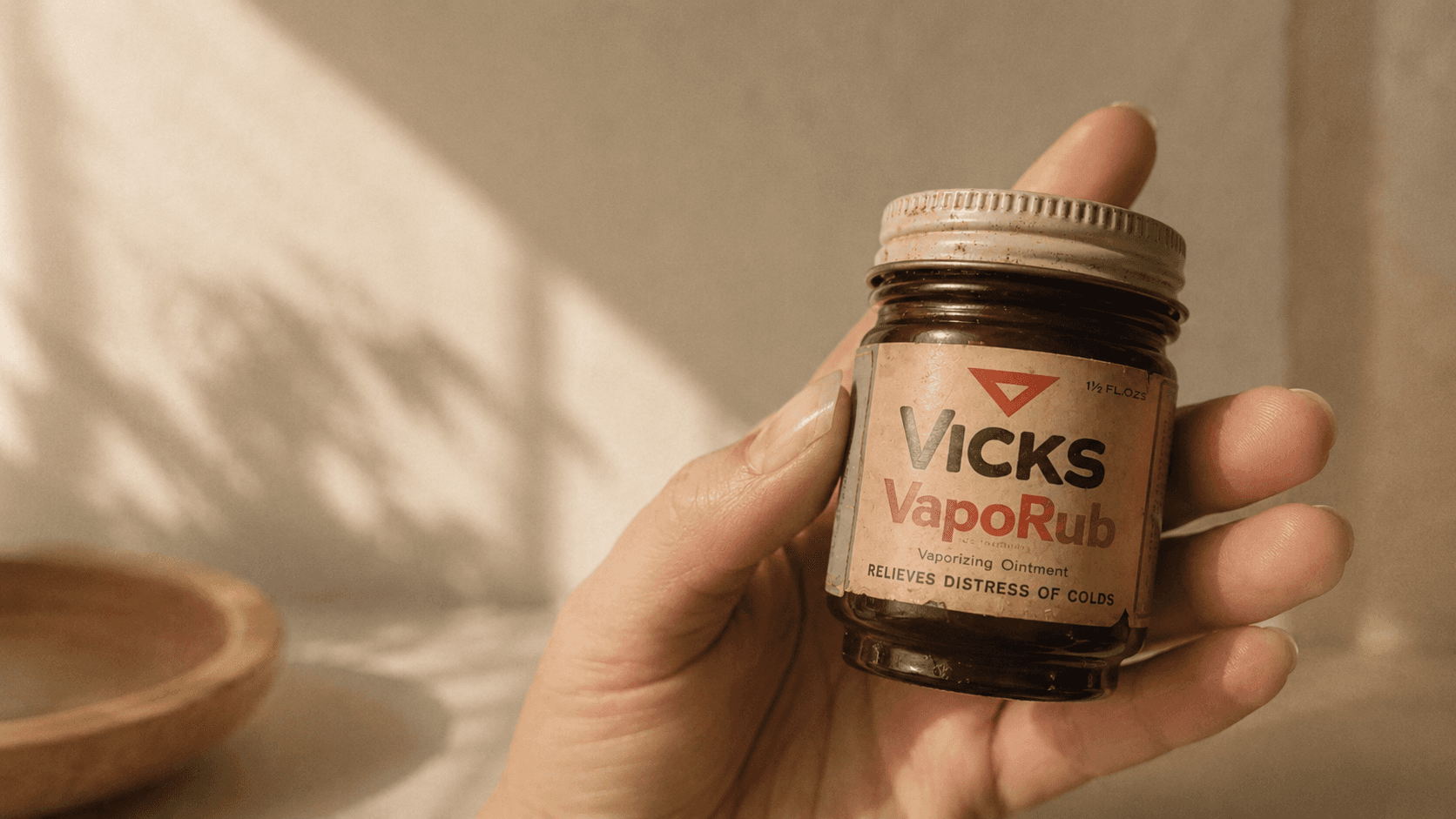
Vicks VapoRub. A 2011 peer-reviewed study saw a 27.8% complete cure rate after 48 weeks of daily application. The chemistry works. The smell, the stains on the sheets, and the petroleum jelly base are why most people quit before it has time to work. We wrote about Vicks separately if you want the long version. If you can stick with it, it's the most affordable evidence-based option on the shelf.
Undecylenic acid OTC products. The pharmacy ingredient that's been in topical antifungals since the 1940s. Sold under various drugstore brand names, sometimes in pen-style applicators, sometimes in small bottles. Inexpensive. Decent track record in the Reddit threads. Effectiveness depends heavily on whether you're filing the nail down so it can penetrate.
Prescription topicals. Several different molecules, prescribed by a podiatrist or dermatologist, often expensive and frequently not covered by insurance because nail issues are classified as cosmetic. Cure rates in trials run roughly 15-35% depending on which one. Worth asking your podiatrist about if the OTC route hasn't moved in six months.
Veto. The reason we made it. Two decades cycling through the options above, some worked partially, none held. So we created the brush-on we wished existed. Camphor and menthol from the medicine-cabinet tradition, paired with undecylenic acid and conditioning oils that improve the appearance of the visible nail. The bottle small enough to live on the counter. The brush that delivers in about a minute, without the mess. Veto is a cosmetic, not a drug. The conditioning oils improve and maintain the appearance of damaged toenails. We're not antifungal. We're not a treatment for any medical condition.
Pick whichever one fits your life. The routine is what does the work. The product is what you actually keep using for a year. The best topical is the one you don't quit.
Tea tree, Vicks, an OTC pen, a prescription, or Veto. Pick one. Stick with it for six months. The routine matters more than the bottle.
08The honest version.
The truth nobody puts on a label is that the product matters less than the routine, and the routine matters less than the duration.
You will see almost nothing for the first two months. By month four, you'll see clean new growth at the cuticle. By month eight, more than half the visible nail will be nail you grew during the routine. By month twelve, the whole visible nail is one you grew. That's the actual timeline.
Do the three minutes every night. File once a week. Photograph once a month. Reassess every six. Don't switch products every few weeks. Don't compare night-to-night.
That's the whole thing. Pick a topical you can stand to use for a year. Build the bottle into your evening so you can't avoid it. Then trust the biology to do its slow, unimpressive, completely reliable work.
If you want the brush-on we created for exactly this routine, that's Veto. If Vicks, tea tree, or something from the pharmacy works for your situation, that's a good answer too.
The routine is what works. The bottle is whichever one you'll actually keep using.
*Veto is a cosmetic and is not a treatment for any medical condition.
References
- Geyer AS, Onumah N, Uyttendaele H, Scher RK. Modulation of linear nail growth to treat diseases of the nail. Journal of the American Academy of Dermatology, 2004. Average toenail linear growth rate of approximately 1 millimeter per month in healthy adults.
- Buck DS, Nidorf DM, Addino JG. Comparison of two topical preparations for the treatment of onychomycosis: Melaleuca alternifolia (tea tree) oil and clotrimazole. Journal of Family Practice, 1994. Approximately 18% cure rate after six months of twice-daily tea tree oil application.
- Derry CJ, Derry S, Moore RA. Vicks VapoRub for treating fungal toenail infections. Pilot study, 2011. 27.8% complete cure rate, 55.6% partial cure, in 18 patients applying VapoRub daily for 48 weeks.
- Standard podiatry practice references on daily nail care for damaged or compromised nails. The five-step sequence (clean, dry, file, apply, rest) is consistent across professional sources, with minor variation in filing frequency.
- Clinical literature on consistency vs. intensity in topical treatment regimens. Long-duration daily application is the strongest predictor of outcomes in topical onychomycosis trials, regardless of active ingredient.
- Internal Veto customer survey, 2026. Beta cohort of 2,500 customers reporting routine adherence and outcomes during their first 12 months. 80% would recommend Veto to a friend.