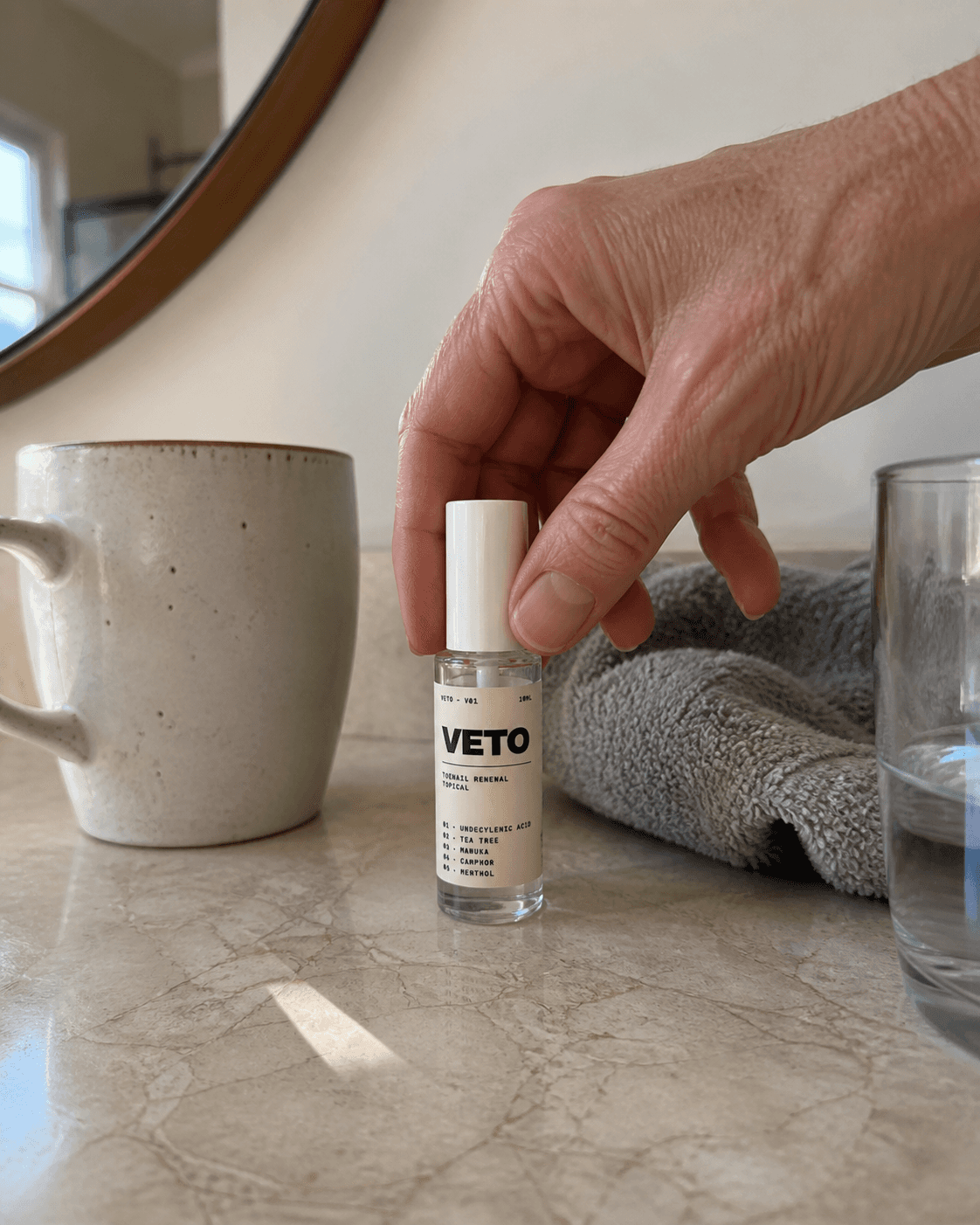
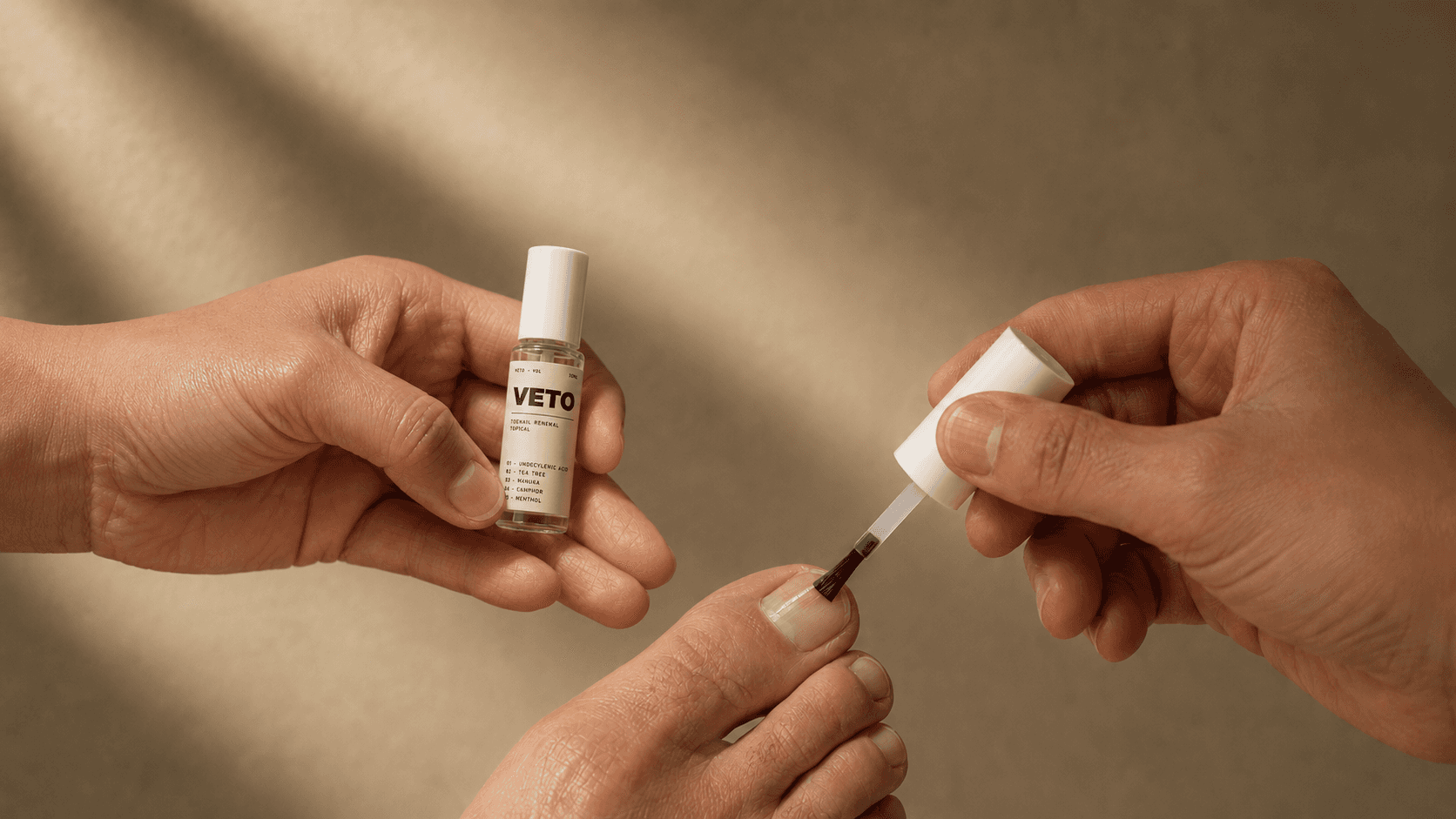
Toenails worth showing again.
Improves the appearance, texture, and condition of damaged, discolored nails.
Improves the appearance, texture, and condition of damaged, discolored nails.
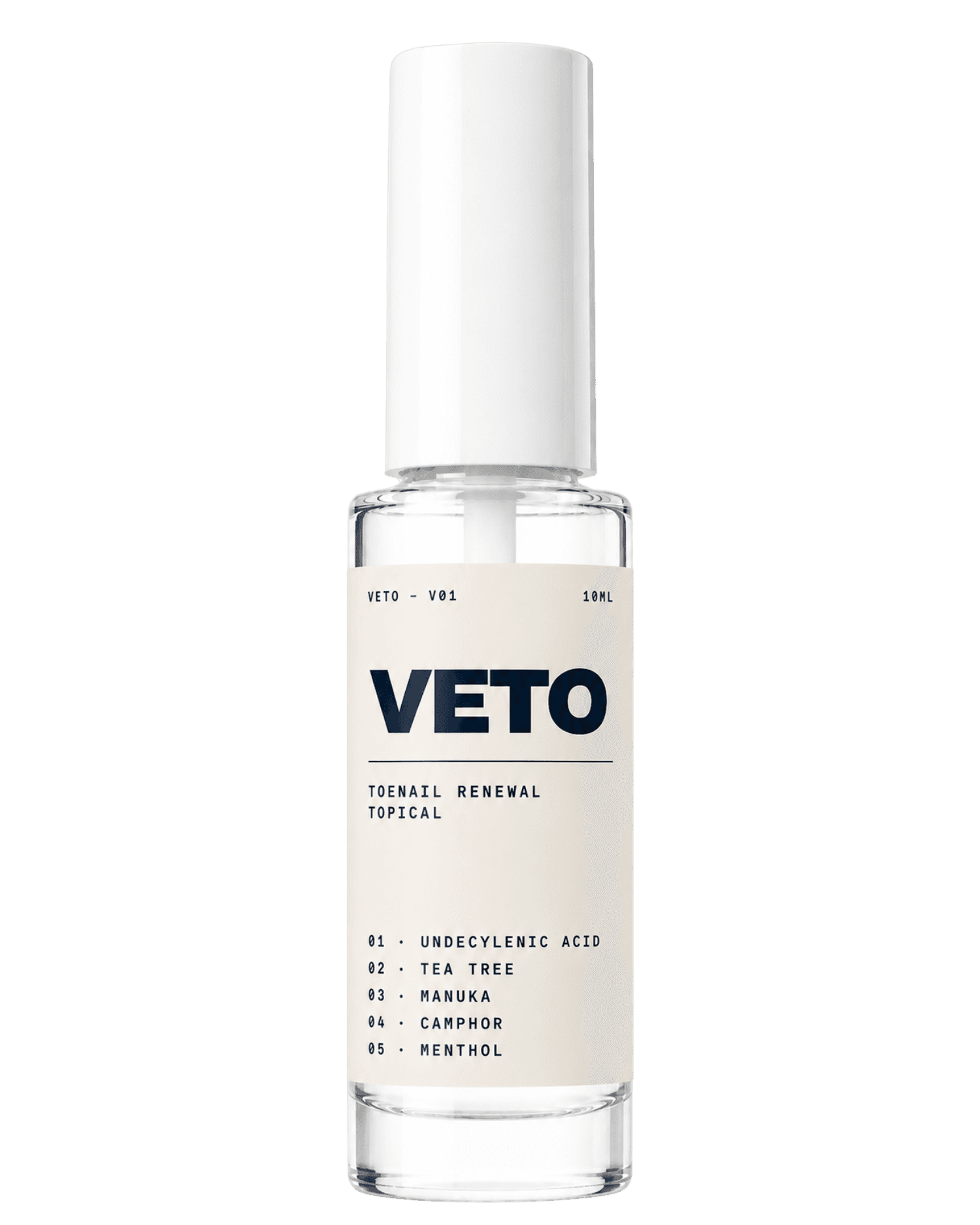

Veto pairs pharmacy chemistry with traditional medicine cabinet wisdom.
Veto pairs pharmacy chemistry with traditional medicine cabinet wisdom.
01
Improves and maintains toenail appearance.
Damaged toenails don't get fixed in 14 days. They get better over time, with a routine you actually keep. Whether you're new to this, tried home remedies, declined the prescription, or finished a course and want what comes after, the question is the same: what's the daily routine that fits into your evening?
Veto is built for that. The kind of long-term routine podiatrists recommend to help protect healthy nail appearance
01
Improves and maintains toenail appearance.
Damaged toenails don't get fixed in 14 days. They get better over time, with a routine you actually keep. Whether you're new to this, tried home remedies, declined the prescription, or finished a course and want what comes after, the question is the same: what's the daily routine that fits into your evening?
Veto is built for that. The kind of long-term routine podiatrists recommend to help protect healthy nail appearance
02
83% agree
A pattern has been hiding in the research on toenail care. In 2011, researchers tested the classic household chest rub on toenails for the first time. 83% of participants saw visibly improved nail appearance. 1 in 4 reported fully clear nails. The pattern goes deeper. Tea tree outperformed the active in a leading drugstore foot care product across 117 patients. Two home remedies, decades of supporting research. Just never built for the nail. Meanwhile, undecylenic acid has been there the whole time. Quietly credible. Trusted in pharmacy formulations since the 1940s.
Veto is the bottle that finally brought them together.
02
83% agree
In 2011, the Journal of the American Board of Family Medicine ran a 48-week pilot on people with thickened, discolored toenails. The instruction? Rub a well-known mentholated chest rub on the toenail every night. The result? 83% saw visible improvement. 1 in 4 had toenails grow back fully clear. Small study. No placebo. Just a greasy ointment built for chest colds — that actually improved toenails. The study went largely unnoticed — found only by the few willing to live with the mess for the sake of the result. So we took what worked, and added what was missing: a pharmacy ingredient drawn from the same plant-based lineage. Just for toenails. None the mess.
Veto is the bottle that finally brought them together.
02
83% agree
A pattern has been hiding in the research on toenail care. In 2011, researchers tested the classic household chest rub on toenails for the first time. 83% of participants saw visibly improved nail appearance. 1 in 4 reported fully clear nails. The pattern goes deeper. Tea tree outperformed the active in a leading drugstore foot care product across 117 patients. Two home remedies, decades of supporting research. Just never built for the nail. Meanwhile, undecylenic acid has been there the whole time. Quietly credible. Trusted in pharmacy formulations since the 1940s.
Veto is the bottle that finally brought them together.
02
83% agree
A pattern has been hiding in the research on toenail care. In 2011, researchers tested the classic household chest rub on toenails for the first time. 83% of participants saw visibly improved nail appearance. 1 in 4 reported fully clear nails. The pattern goes deeper. Tea tree outperformed the active in a leading drugstore foot care product across 117 patients. Two home remedies, decades of supporting research. Just never built for the nail. Meanwhile, undecylenic acid has been there the whole time. Quietly credible. Trusted in pharmacy formulations since the 1940s.
Veto is the bottle that finally brought them together.
03
No pill. No prescription. No question mark over your liver.
The pill that doctors prescribe for toenail conditions works for some people. It also carries documented liver risk, requires periodic liver function tests, and interacts with a long list of common medications. That's a trade most people aren't willing to make for a cosmetic concern.
Veto is topical. It stays on your toenail. Nothing reaches your bloodstream. Nothing your doctor needs to monitor.
03
No pill. No prescription. No question mark over your liver.
The same pharmacy-grade antifungal ingredient pharmacy nail products have used since the 1940s. Derived from castor oil. Eight decades of pharmacy use behind it.
Veto is topical. It stays on your toenail. Nothing reaches your bloodstream. Nothing your doctor needs to monitor.
03
No pill. No prescription. No question mark over your liver.
The pill that doctors prescribe for toenail conditions works for some people. It also carries documented liver risk, requires periodic liver function tests, and interacts with a long list of common medications. That's a trade most people aren't willing to make for a cosmetic concern.
Veto is topical. It stays on your toenail. Nothing reaches your bloodstream. Nothing your doctor needs to monitor.
03
No pill. No prescription. No question mark over your liver.
The pill that doctors prescribe for toenail conditions works for some people. It also carries documented liver risk, requires periodic liver function tests, and interacts with a long list of common medications. That's a trade most people aren't willing to make for a cosmetic concern.
Veto is topical. It stays on your toenail. Nothing reaches your bloodstream. Nothing your doctor needs to monitor.
04
A clean brush-on. None of the mess.
The chest rub on the nightstand. The bandaid wrapped around the toe at night. The sock you wear to bed so nothing else gets ruined. The bottle you hide before company comes over.
Veto absorbs in minutes. Brush, dry, done. The bottle stays on the counter. No one asks what it is.
04
A clean brush-on. None of the mess.
The chest rub on the nightstand. The bandaid wrapped around the toe at night. The sock you wear to bed so nothing else gets ruined. The bottle you hide before company comes over.
Veto absorbs in minutes. Brush, dry, done. The bottle stays on the counter. No one asks what it is.
05
Real renewal. At the pace your nails grow.
Most people see early visible changes in 2 to 8 weeks. Toenails grow 1mm per month. Full grow-out takes 6 to 12 months. No product changes that. What changes faster is the look of the nail you already have. Veto's conditioning oils (sweet almond, jojoba, vitamin E) soften and smooth from the first weeks. That's biology, not Veto's pace.
Veto is not a quick fix. Designed for daily use, and the patience biology takes.
05
Real renewal. At the pace your nails grow.
Most people see early visible changes in 2 to 8 weeks. Toenails grow 1mm per month. Full grow-out takes 6 to 12 months. No product changes that. What changes faster is the look of the nail you already have. Veto's conditioning oils (sweet almond, jojoba, vitamin E) soften and smooth from the first weeks. That's biology, not Veto's pace.
Veto is not a quick fix. Designed for daily use, and the patience biology takes.
Veto by name.
Veto by nature.
We built Veto for everyone whose vocabulary had become no. No to the pill. No to the drugstore aisle. No to the home remedy that worked but ruined the sheets. Veto is the yes we built ourselves.

%
users would recommend Veto™ to a friend.
Read why the other 20% didn't →
Days
is what the drugstore aisle promises. The existing nail starts looking better around 2–8 weeks. Full grow-out takes 6–12 months. We won't sell you a lie about your own biology.
The comparison we wish we'd had
We compared Veto with every other option we tried.
| Prescription | Drugstore | Home Remedy | VETO | |
|---|---|---|---|---|
| Made for toenails | ✓ | ✗ | ✗ | ✓ |
| No prescription | ✗ | ✓ | ✓ | ✓ |
| No bloodwork | ✗ | ✓ | ✓ | ✓ |
| Minimal mess | ✓ | ✓ | ✗ | ✓ |
| No miracle claims | ✗ | ✗ | ✓ | ✓ |
| Looks like skincare | ✗ | ✗ | ✗ | ✓ |
| Daily long-term use | ✗ | ✗ | ✓ | ✓ |
*Veto is a cosmetic and is not a treatment for any medical condition.
For toenails that need a little help
Yellowing
Dryness
For toenails damaged by fungus
Appearance
Conditioning
Brittleness
After prescription antifungals
Smoother texture
Damaged nails
Long-term maintenance
Daily use
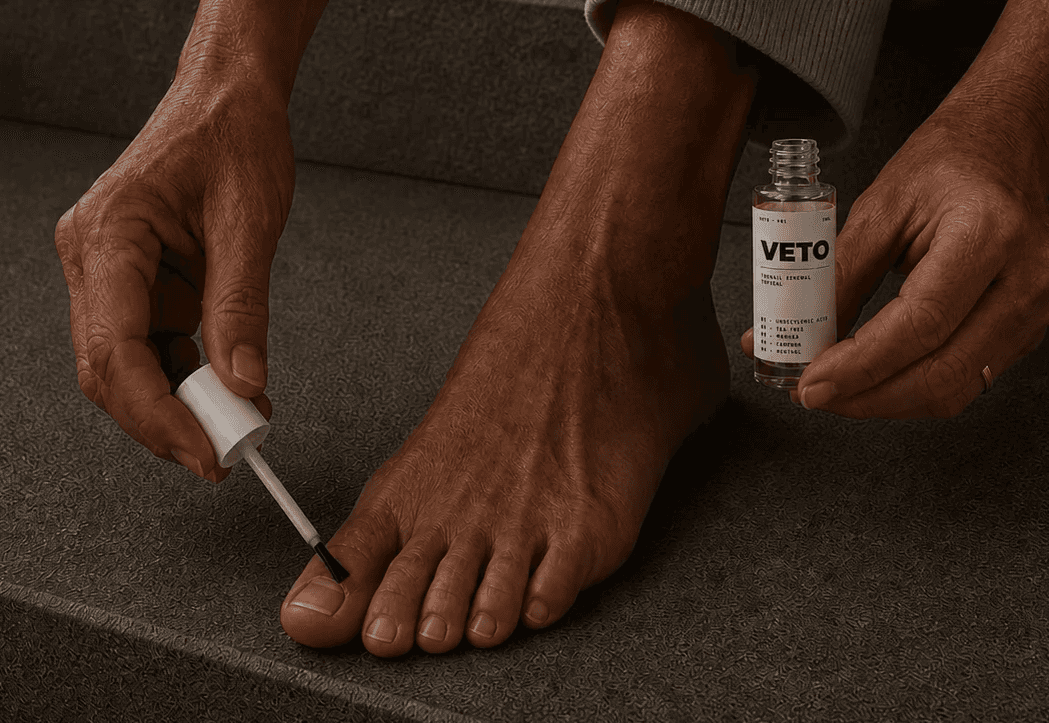
ingredients
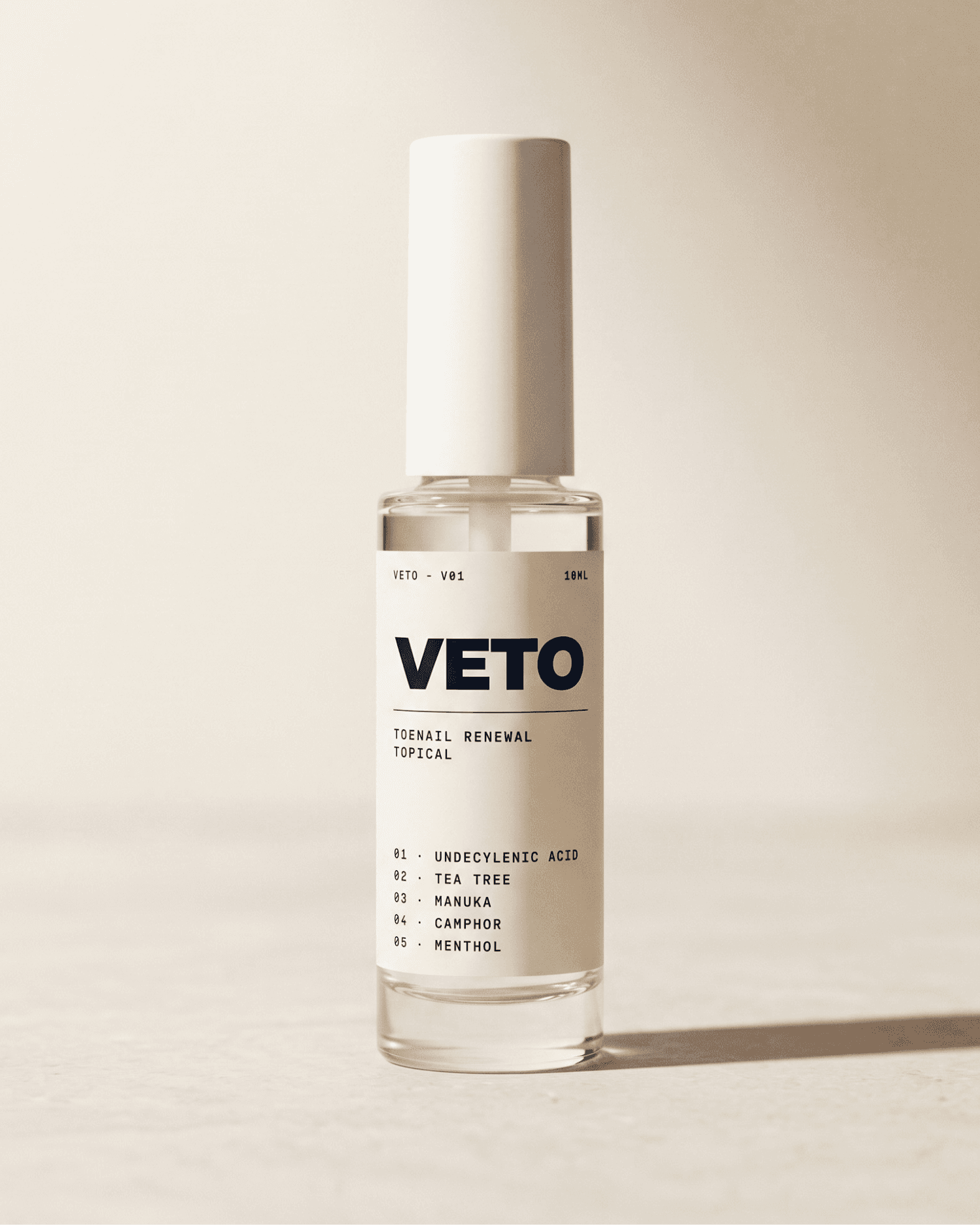
Every one named on the bottle. Every one disclosed.
Every one named on the bottle. Every one disclosed.
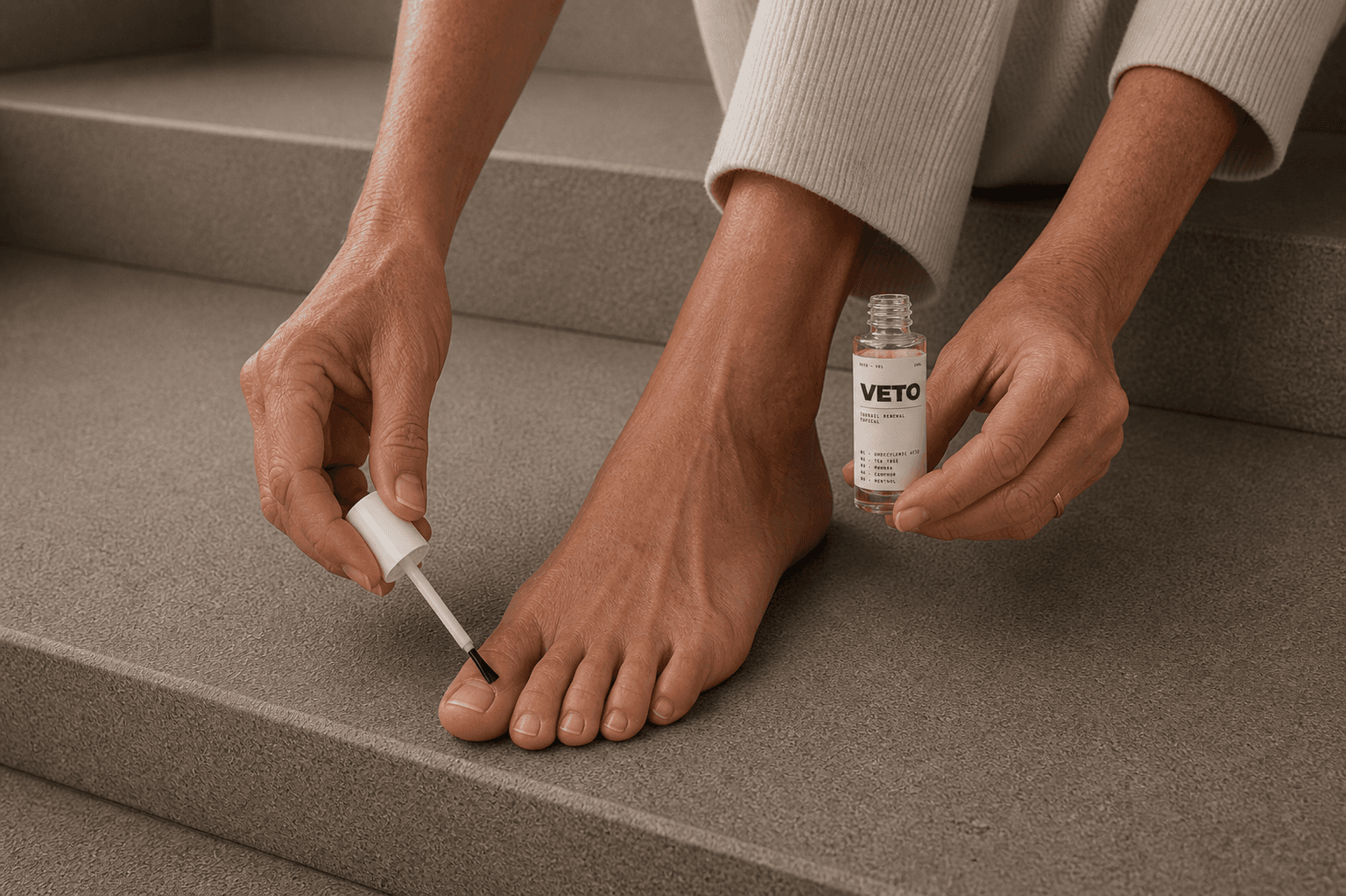
Brush it on every night. Simple.
Brush it on every night. Simple.

Step 01
Clean
Clean and dry the nail. Best after a shower when the nail is softest.

Step 02
Apply
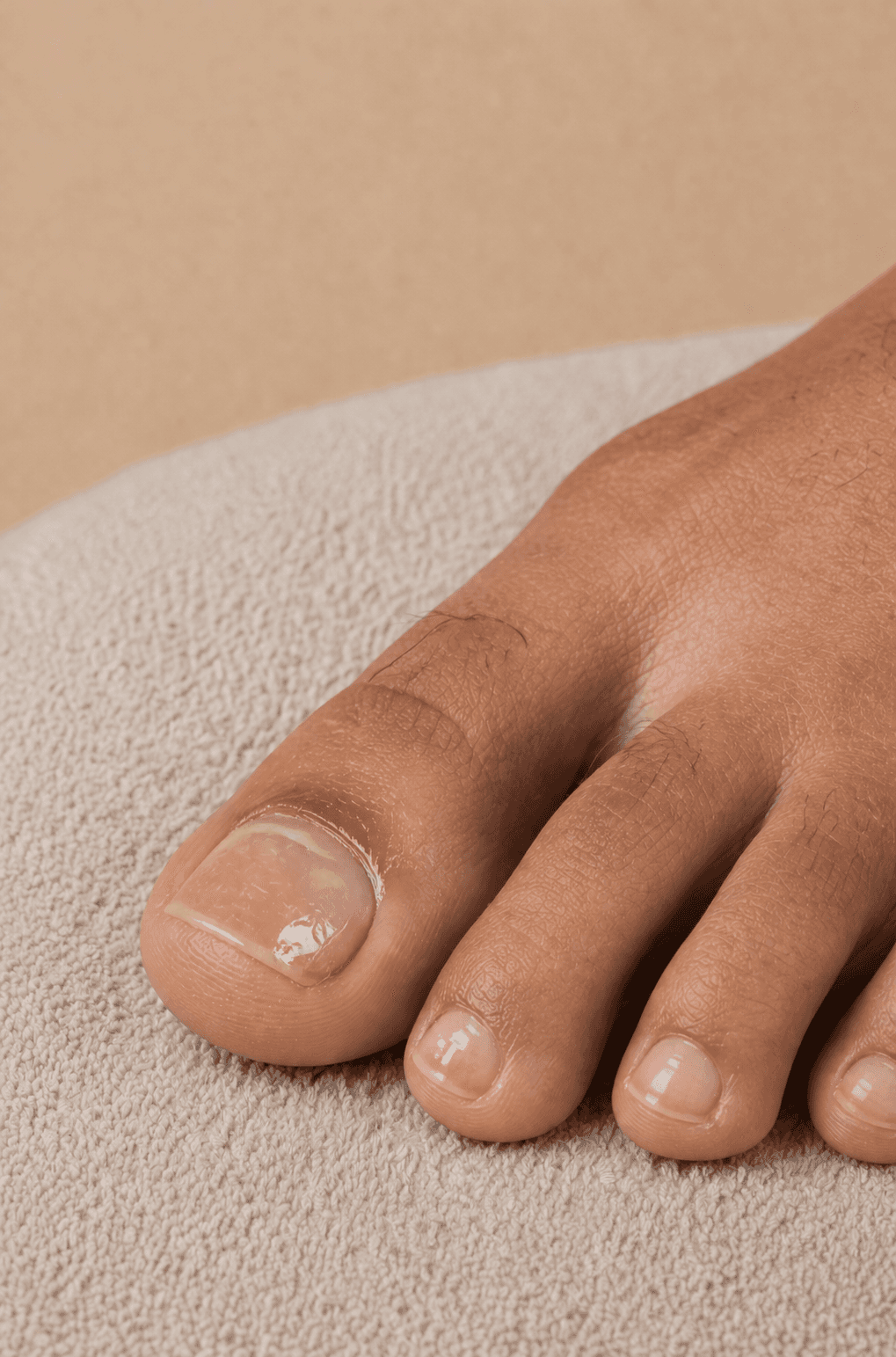
Brush directly onto the nail and surrounding skin. The bristle brush delivers the formula where it needs to go.
Step 03
Let it work
Allow a few minutes to absorb before socks or shoes. Apply once or twice daily, ideally before bed.
Step 01
Clean
Clean and dry the nail. Best after a shower when the nail is softest.
Step 02
Apply
Brush directly onto the nail and surrounding skin. The bristle brush delivers the formula where it needs to go.
Step 03
Let it work
Allow a few minutes to absorb before socks or shoes. Apply once or twice daily, ideally before bed.
What's in the bottle —
and why each ingredient is there.
Every ingredient in Veto is named. Every one is there for a reason. The five above lead the formula. Twelve more carry, nourish, and round it out. Seventeen total. Nothing buried.
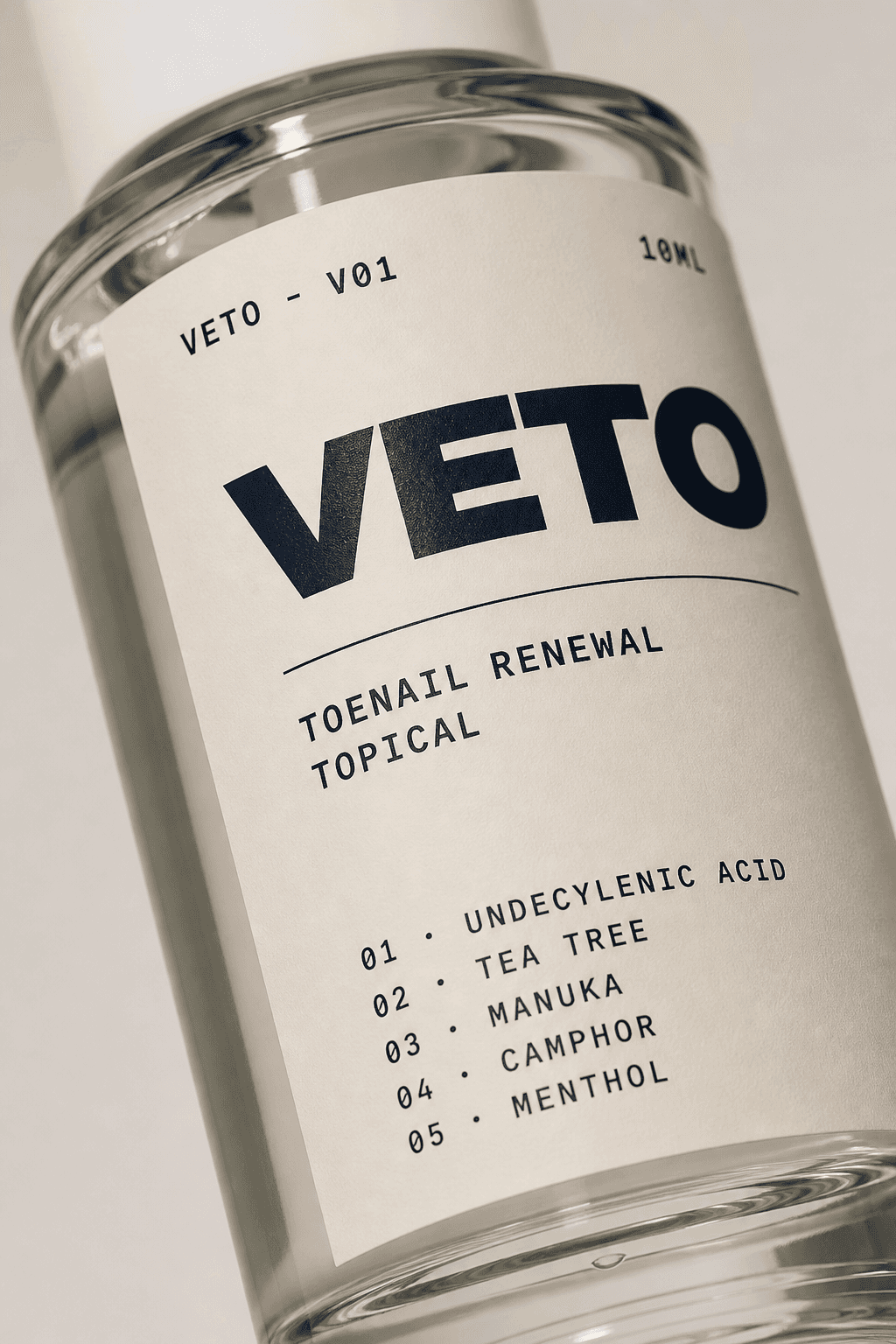
Featured Ingredients
Undecylenic Acid
Ingredient 01
From castor oil. The ingredient pharmacy topicals have been built around since the 1940s. Older than most of what's on shelves today.
Tea Tree
Ingredient 02
Manuka
Ingredient 03
Camphor
Ingredient 04
Menthol
Ingredient 05
+12 more
Full ingredient list
Made in the USA
01
Every bottle is mixed, filled, and labeled in the United States. The supply chain stays local. So does the accountability.
Podiatrist recommended
02
Podiatrists recommend Veto for people who've completed prescription antifungal treatment and want a daily routine to maintain a healthy nail appearance — and for people managing toenail appearance more generally
60-day guarantee
03
If Veto isn't right for you within the first 60 days, we send your money back. We'd rather lose a sale than make one we can't stand behind.
We've been there.
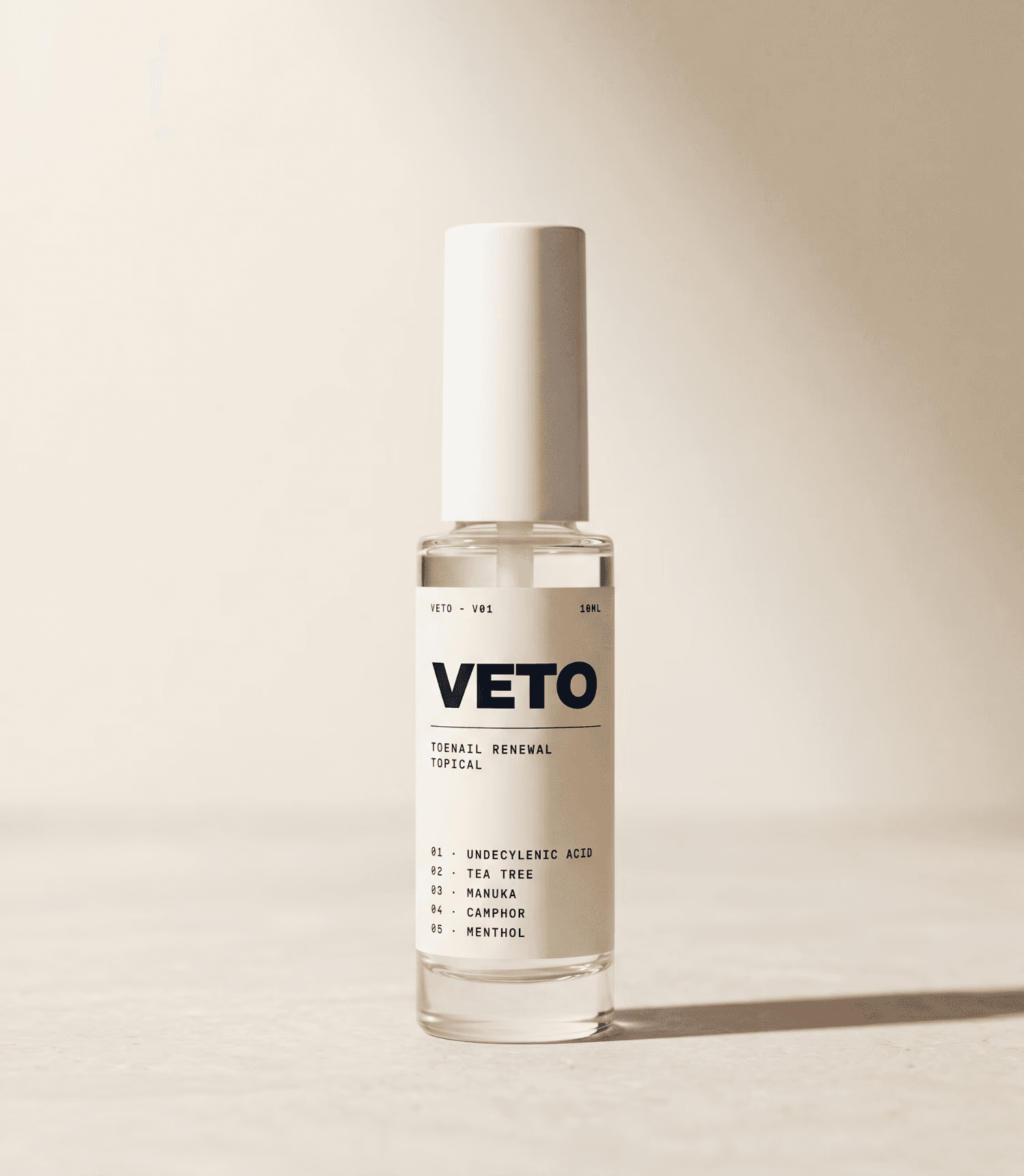
We spent two decades cycling through drugstore picks, home remedies, prescriptions, and even considered surgery. Some worked partially. None held. The damage came back every time we stopped. So we made the routine we needed.

Commitment, both ways.
We bring honest timelines, real people on the other end of an email, and presence for however many months it takes. You bring the bottle to your bathroom shelf, the brush to your nail every night, and the patience the timeline asks for.
Reviews from our first 100 customers
Join the community that's redefining toenail care, one ingredient at a time.

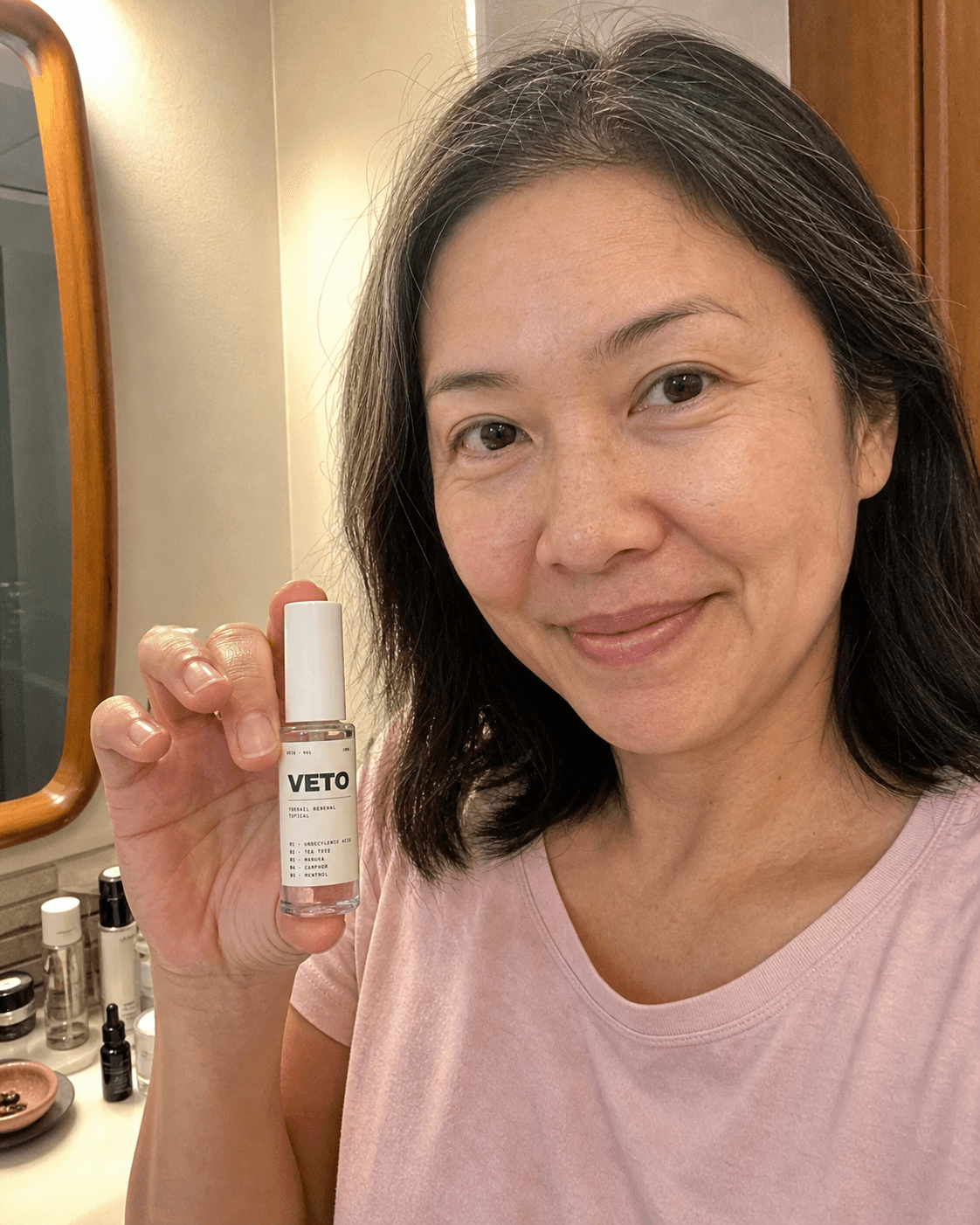


Doc told me terbinafine. Read up on the liver thing and I said no thank you. Spent close to a year running through Vicks, tea tree oil, vinegar soaks, all the home tricks my mama would've known. Veto is the first one I haven't quit on after a few weeks. Two months in, the nails look noticeably better, and I'm not hiding my feet at the pool anymore.
Linford Johnson
age 54, Cleveland
Doc told me terbinafine. Read up on the liver thing and I said no thank you. Spent close to a year running through Vicks, tea tree oil, vinegar soaks, all the home tricks my mama would've known. Veto is the first one I haven't quit on after a few weeks. Two months in, the nails look noticeably better, and I'm not hiding my feet at the pool anymore.
Linford Johnson
age 54, Cleveland
Had this for fourteen years. Tried what most people try — Vicks, tea tree, drugstore shelves, the prescription I wouldn't take. Nothing stuck for long. My wife handed me a bottle of Veto last fall and told me to give it a real shot. Six months later I'm still using it. Nails look more like nails than they have in years. That's a long time to be wrong about something working.
George McCartney
CPA, retired - 6 months on Veto
Had this for fourteen years. Tried what most people try — Vicks, tea tree, drugstore shelves, the prescription I wouldn't take. Nothing stuck for long. My wife handed me a bottle of Veto last fall and told me to give it a real shot. Six months later I'm still using it. Nails look more like nails than they have in years. That's a long time to be wrong about something working.
George McCartney
CPA, retired - 6 months on Veto
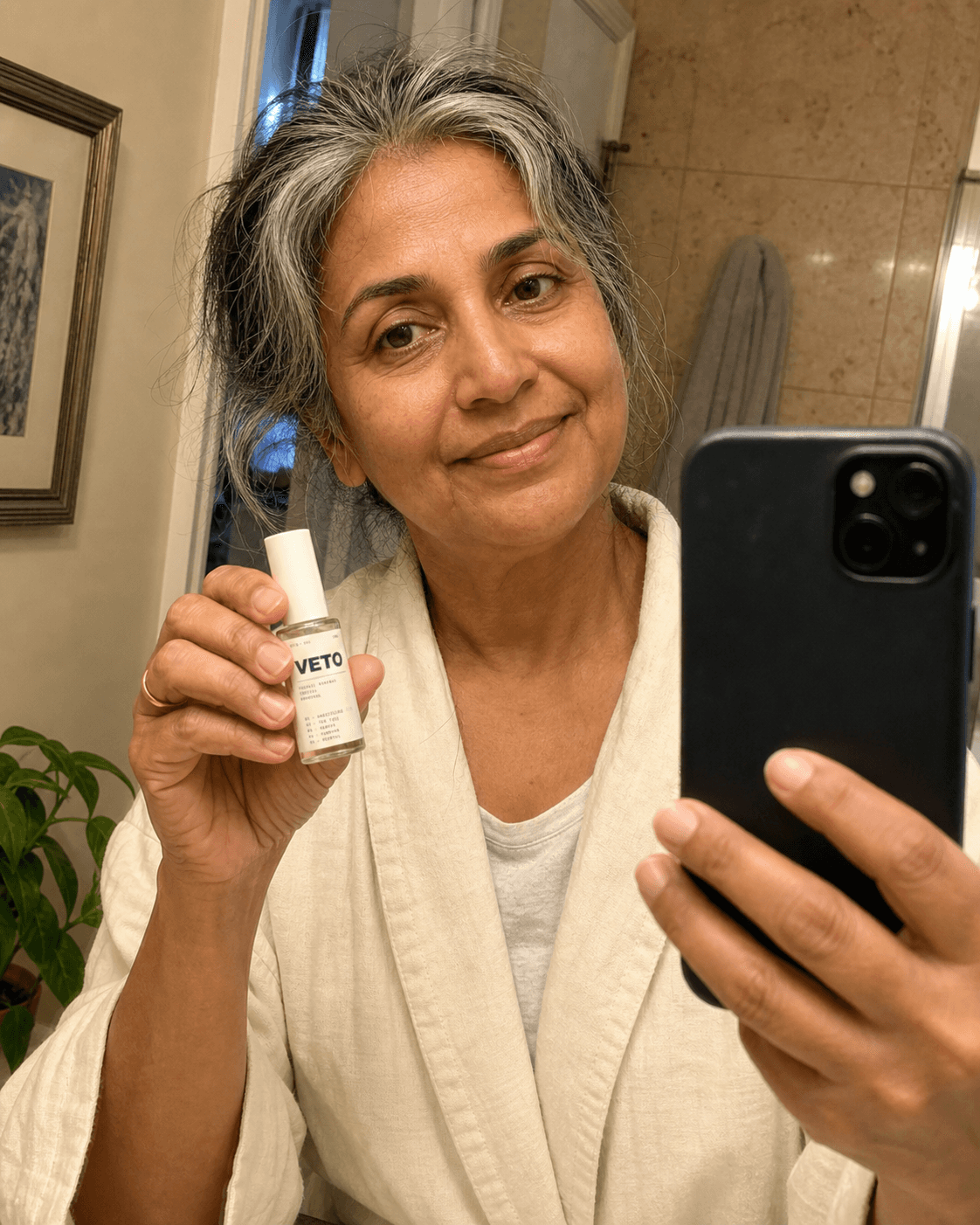
I tried Vicks for almost two years. It worked for me eventually but my god, the greasy sheets. My husband legitimately threatened to make me sleep in the spare room. Veto has the camphor and menthol I'd come to trust, but I can put it on, brush my teeth, and get into bed without staining everything I own. Same routine, way less laundry, and my husband's still talking to me.
Sunny Patel
formerly used home remedy
I tried Vicks for almost two years. It worked for me eventually but my god, the greasy sheets. My husband legitimately threatened to make me sleep in the spare room. Veto has the camphor and menthol I'd come to trust, but I can put it on, brush my teeth, and get into bed without staining everything I own. Same routine, way less laundry, and my husband's still talking to me.
Sunny Patel
formerly used home remedy
I'm 52 and I tried everything over the years, nothing stuck. My wife saw the ad and said just try it. So fine, I tried it. I'm an engineer, so first thing I did was read the ingredient list and look up every component. Undecylenic acid checks out. The botanicals check out. Six weeks in, there was a visible difference at the base of the nail where the new growth comes in. Six months in, the difference is hard to argue with. My wife is enjoying being right.

Mario Ortega
using Veto for 6 months
I'm 52 and I tried everything over the years, nothing stuck. My wife saw the ad and said just try it. So fine, I tried it. I'm an engineer, so first thing I did was read the ingredient list and look up every component. Undecylenic acid checks out. The botanicals check out. Six weeks in, there was a visible difference at the base of the nail where the new growth comes in. Six months in, the difference is hard to argue with. My wife is enjoying being right.
Mario Ortega
using Veto for 6 months
I'm 52 and I tried everything over the years, nothing stuck. My wife saw the ad and said just try it. So fine, I tried it. I'm an engineer, so first thing I did was read the ingredient list and look up every component. Undecylenic acid checks out. The botanicals check out. Six weeks in, there was a visible difference at the base of the nail where the new growth comes in. Six months in, the difference is hard to argue with. My wife is enjoying being right.
Mario Ortega
using Veto for 6 months
Haven't worn open-toed shoes since 2018. My sister's wedding is in six months, and I gave myself permission to try one more thing. The bottle doesn't look like a foot care product, which honestly I appreciate. It's been on my bathroom counter for three months and nobody's asked what it is. Nails are looking better. Cautiously optimistic about June.
Sarah Mitchell
proud sandal wearer
Haven't worn open-toed shoes since 2018. My sister's wedding is in six months, and I gave myself permission to try one more thing. The bottle doesn't look like a foot care product, which honestly I appreciate. It's been on my bathroom counter for three months and nobody's asked what it is. Nails are looking better. Cautiously optimistic about June.
Sarah Mitchell
proud sandal wearer
Marathon runner here. Lost my big toenail more times than I can count. Tried the things you'd expect a runner to try — every training cycle, the damage comes back because my feet live in wet shoes for hours. Veto isn't a cure for what causes it. But the discoloration and brittleness stay manageable in a way nothing else has done. Brush it on after every long run. Easy add to the routine

Mike Kimble
marathon runner
Marathon runner here. Lost my big toenail twice. Tried everything you'd expect a runner to try, and the damage comes back every training cycle because my feet live in wet shoes for hours. Veto isn't a cure for what causes it, but the discoloration and brittleness stay manageable in a way nothing else has done. Brush on after every long run. Easy add to the routine.
Mike Kimble
marathon runner
Marathon runner here. Lost my big toenail more times than I can count. Tried the things you'd expect a runner to try — every training cycle, the damage comes back because my feet live in wet shoes for hours. Veto isn't a cure for what causes it. But the discoloration and brittleness stay manageable in a way nothing else has done. Brush it on after every long run. Easy add to the routine
Mike Kimble
marathon runner


Veto™
$49
Ships January 2027
Improves the Appearance, Texture, and Condition of Damaged, Discolored Nails.
Aa daily toenail renewal topical that brushes on in seconds. Undecylenic acid, the topical ingredient trusted by pharmacies since the 1940s, paired with the botanicals home remedies have reached for over generations, for the combination toenails have been waiting for.

We offer free shipping on all orders and they typical ship within 1-2 business days. US orders typically arrive in 3-5 business days with standard shipping or 2-3 days with expedited shipping. International orders generally arrive within 7-14 business days, depending on your location.
We offer a 30-day satisfaction guarantee. If you're not completely satisfied with your Veto product, you can return it within 30 days of receipt for a full refund of your purchase price.
We offer free shipping on all orders and they typical ship within 1-2 business days. US orders typically arrive in 3-5 business days with standard shipping or 2-3 days with expedited shipping. International orders generally arrive within 7-14 business days, depending on your location.
We offer a 30-day satisfaction guarantee. If you're not completely satisfied with your Veto product, you can return it within 30 days of receipt for a full refund of your purchase price.
We offer free shipping on all orders and they typical ship within 1-2 business days. US orders typically arrive in 3-5 business days with standard shipping or 2-3 days with expedited shipping. International orders generally arrive within 7-14 business days, depending on your location.
We offer a 30-day satisfaction guarantee. If you're not completely satisfied with your Veto product, you can return it within 30 days of receipt for a full refund of your purchase price.
We offer free shipping on all orders and they typical ship within 1-2 business days. US orders typically arrive in 3-5 business days with standard shipping or 2-3 days with expedited shipping. International orders generally arrive within 7-14 business days, depending on your location.
We offer a 30-day satisfaction guarantee. If you're not completely satisfied with your Veto product, you can return it within 30 days of receipt for a full refund of your purchase price.
Made In the USA
60-Day Money-Back Guarantee
Sustainable Packaging
Free Shipping
Secure Payment
Frequently asked questions.
The category has trained you to be skeptical of "this works" claims — and rightly so. Most products in this space promise transformation and deliver hope. What we offer instead is honest data. A 2011 peer-reviewed pilot study published in the Journal of the American Board of Family Medicine tested the classic mentholated chest rub — the camphor and menthol stack from the medicine cabinet — on toenails. After 48 weeks of daily use, 83% of participants saw visible improvement. 1 in 4 had nails that grew back clear. Veto combines that camphor and menthol family with tea tree, manuka, and undecylenic acid — a fatty acid used in topical pharmacy products since the 1940s — in a brush-on format. We're not going to tell you Veto works for everyone — no product does. We're going to tell you what the research shows and what real users have reported, and let you decide whether Veto earns a try.
No topical works for everyone. Anyone telling you otherwise is selling you a fantasy. Here's who Veto isn't for, in our experience. The condition isn't what they thought it was. A meaningful percentage of people who self-diagnose as having toenail fungus turn out to have nail damage from other causes — chemical damage from polish, repeated trauma from running shoes or work boots, age-related changes, or psoriasis affecting the nail. A topical for fungal damage won't help if the underlying issue isn't fungal. A podiatrist can tell you which one you're looking at. The damage is past what a topical can reach. Veto works at the surface and edge of the visible nail. If the nail is severely thickened across the full plate, the underlying nail bed is involved, or there's pain, bleeding, or rapid spreading — see a doctor first. A topical isn't the right starting point. They stopped too early. Toenails grow about 1mm per month. The most common reason any topical "doesn't work" is four to six weeks of use, no dramatic change, and giving up. Veto isn't different on this. Skip consistency and nothing else matters. They need the prescription, not a topical. Some advanced fungal infections require oral terbinafine. If your podiatrist has told you that's the path, Veto won't substitute for it. (Veto can sit alongside or after prescription antifungals as cosmetic care, but only as a complement.) If you've used Veto consistently for six months and haven't seen change, that's a real signal — and we'd rather you stop and see a podiatrist than keep buying something that isn't right for you. Email us at support@ohveto.com and we'll help you decide.
Because we're not going to lie to you about how nails grow. Toenails grow at about 1mm per month. That's biology. The visible nail you see today is the nail you'll have for the next several months. There's no product on Earth — over-the-counter, prescription, or otherwise — that can change that physical fact. So when a brand says "results in 14 days" or "cure in 28 days," one of two things is happening. Either they're describing surface-level cosmetic changes to the existing nail (real, but not what you think they mean), or they're lying. Veto does deliver visible changes early — usually 2 to 8 weeks for the existing nail to start looking better, as the conditioning oils work on the surface. The 17 ingredients in Veto include sweet almond oil, jojoba, vitamin E, and mineral oil — all of which condition the nail you have right now. That work shows up quickly. But the actual nail won't grow back fully for 6 to 12 months, and we'd rather tell you that upfront than lose you to disappointment when "14 days" doesn't deliver what you imagined. The brands lying about timelines aren't doing you any favors. They're betting you'll forget the disappointment, blame yourself, and try the next product they sell. We're betting you'll respect the truth and stay long enough to see it work.
The home remedies you've tried — tea tree, camphor, menthol, the ointment in the medicine cabinet — are ingredients people have reached for over generations. A 2011 peer-reviewed study tested the mentholated chest rub specifically and reported that 83% of participants saw visible improvement in nail appearance over 48 weeks. The home remedies aren't folklore — they're underdosed and inconveniently delivered. The drugstore products you've tried use ingredients drawn from the same family in low concentrations and cheap delivery systems. They make the appearance improve briefly. They don't address the underlying nail. Veto pairs undecylenic acid (a fatty acid derived from castor oil, used in topical pharmacy formulas since the 1940s) with the home-remedy ingredient family in a single brush-on bottle. Without the greasy ointment on your socks and sheets. Without the routine that takes over your evening.
The biggest reason home-remedy treatments underperform isn't the chemistry — it's the delivery. Petroleum-based ointments and balms sit on top of the nail. The fungus lives underneath. People have spent years trying to engineer their own delivery systems for a chest rub that was never designed for nails — pushing it under the edge with q-tips, taping the toe overnight, layering it under socks. Veto is a liquid brush-on, not an ointment. The carriers in the formula spread thinly across and around the nail surface and into the cuticle area where new growth comes in. The brush bristles deliver the formula into the gap between the nail edge and the skin where heavier ointments physically can't reach. For thickened nails, gently filing the surface with an emery board before applying gives any topical a fairer shot. Veto is no different on that front — but the brush-on format means you don't have to engineer your own delivery anymore.
Veto contains mineral oil and other carrier oils, which means a heavy application onto fabric can leave a temporary mark. But because Veto is a thin liquid that absorbs in a few minutes — versus a thick petroleum ointment that sits on the nail for hours — the transfer in real use is much lower. Apply, wait a couple of minutes for it to dry down, then put on socks or get into bed. If you're particularly cautious about bedding, apply at the start of your evening routine — by the time you're in bed, the formula has fully absorbed. What you won't have to do is wrap your toe in a bandaid every night to contain the transfer. That's the workaround the petroleum-ointment generation grew up with. Veto skips it.
Honest answer: yes, a little. We're not going to pretend Veto is invisible after you apply it. Veto is a thin oil-based liquid. It absorbs into and around the nail in a few minutes. Once it's dry, you can put on socks, get into bed, walk on carpet, and not think about it. We've used this product for years across our team and on testers, and at this point we don't even register it as something that could transfer. But within those first few minutes after application, Veto behaves like any oil-based product would behave on skin: it has a slight wet feel, and if you press fabric directly into a freshly applied area before it's absorbed, you'll see a small mark. That mark generally washes out — Veto is not stain-permanent the way some petroleum-based products are. But we won't tell you the marks never appear. Three things people do that work: Apply at the start of your evening routine, not the end. Brush on, do whatever else you do (skincare, brushing teeth, getting ready for bed), and by the time you're getting into bed it's fully absorbed. Wipe excess off the surrounding skin with a tissue if you want a cleaner finish. The nail keeps the formula it needs; the skin around it doesn't need a heavy coat. If you're applying right before putting on socks for the day, give it the same few minutes before sealing it in. What Veto won't do: leave petroleum-based residue that transfers to everything for hours afterward. What Veto will do: behave like a skincare oil on skin during application and absorption.
No. The classic medicine-cabinet remedy is dominated by camphor and menthol — which is what gives it the strong medicinal smell people associate with cold-and-flu products. Veto contains both, but in lower concentrations balanced against tea tree, manuka, lavender, and lemongrass. The scent is mild and botanical — closer to a foot balm than a chest rub. It dissipates within a few minutes of application.
The honest answer: it depends — and any brand telling you otherwise is selling you something other than the truth. A handful of people report visible shine within 24-48 hours. That's not renewal. That's the conditioning oils making the nail surface look better, the way moisturizer makes skin look brighter the day you apply it. Some brands in this category use optical brighteners and silicas to engineer this effect — short-term cosmetic gloss with no underlying improvement. Veto doesn't. What real renewal looks like: most users report the existing nail starting to look healthier around the 2-4 week mark — color softening, surface smoothing. Meaningful visible change typically takes 3-6 months. Full grow-out renewal, where damaged nail has been completely replaced by new healthy growth, takes 6-12 months or longer. Your timeline depends on how much of the nail is affected, how thick or damaged the nail is to start, your age (toenails grow more slowly with age), how often your feet are in damp shoes or socks, and how consistently you apply. The big toe takes longest because it grows slowest. We're not going to give you a single number. The single-number brands are lying. We'll tell you Veto works at the pace your nails grow — and ask you to commit to the timeline that's actually true.
Three things: consistency, patience, and realistic expectations. Consistency means once daily, every day, for months. Not three times a week. Not when you remember. Not until the nail looks better and then sporadically. Toenail renewal happens at the rate of new nail growth — about 1mm per month — which means the formula has to be there every day the nail is growing. Patience means committing to 6 months minimum before judging whether Veto is working for you, and accepting that 12+ months is normal for full grow-out. Most people who say "I tried this product and it didn't work" tried it for 4-6 weeks, didn't see dramatic change, and stopped. Toenails don't move that fast for any product. Veto is no different. Realistic expectations means understanding that Veto is a daily-use cosmetic that helps with the appearance of damaged nails — not a one-time fix. Some users see steady improvement over a year. Some see the nail look meaningfully better within 8 weeks. Some find Veto isn't right for them and stop. We're not going to pretend the outcome is universal. If you're not willing to apply Veto every night for at least 6 months — Veto is not the product for you. We'd rather tell you that upfront.
If you've been at this for years, you've probably tried the drugstore brands, the medicine-cabinet remedy, tea tree oil, vinegar soaks, oregano oil, possibly a podiatrist visit, possibly the prescription pill you decided against. We know the list because we've used it. Here's what most people don't realize about why those failed. The drugstore products legally can't claim to treat toenail fungus — read the back label and most of them disclose, in fine print, that they're not for use on nails. The home remedies aren't underdosed by accident; they're consumer products that were never formulated for this use case. The pill works for some people, but the liver risk and the bloodwork made it a no for you. The gap in the market — and the one Veto fills — is a product that takes the home-remedy ingredients people have been using anyway, adds the pharmacy ingredient those remedies don't include, formulates it specifically for the toenail use case, and delivers it without the mess that turned the home remedies into a nightly project. No topical works for everyone. None ever has. We're saying: if the home remedies were doing partial work and the drugstore products were doing nothing, this is the version that combines what was working with what was missing.
Some products in this category include optical brighteners, silicas, and gloss agents that make the nail look reflective the moment you apply them. That's cosmetic gloss — it sits on the surface, it washes off, and it doesn't change the nail underneath. Veto doesn't include those. We had the choice. We could have added them. They would have made Veto's before-and-after photos look more impressive in the first week. We chose against it because the people we're building Veto for are people who've been disappointed by exactly that move — products that looked great in the bottle and the first day, until it became clear nothing real was happening underneath. What you'll see in the first 2-4 weeks with Veto is the conditioning oils improving the surface of the nail you have right now — softer color, less brittle texture, healthier appearance. That's real, but it's not renewal. The change you're actually buying — new healthy nail growing in — takes 6-12 months. We'd rather you see slower real change than fast fake change.
Probably yes. And the brands that tell you otherwise are selling you a fantasy. Toenail conditions caused by daily wear, repeated moisture exposure, age, or fungal damage are recurrent by nature. Most products that help with appearance don't permanently solve the underlying conditions, because the conditions themselves come from how you live — the shoes, the gyms, the pools, the polish, the years — not from a single fixable cause. Some users who've tried home-remedy approaches long-term also report that single-ingredient treatments seem to "stop working" after a few weeks — the fungus appears to adapt. Single-ingredient routines also tend to be hard to sustain — one note, gets old, gets skipped. Veto's multi-ingredient formula is designed for daily long-term use, with multiple botanicals and conditioning oils so the routine has more to give over time. Consistency is what makes any topical work, and a richer formula is easier to stick with. Veto is designed for daily use over the long term. Built into your routine, not a one-time fix. If your nails look better while you're using it and worse when you stop, that's because you're using a daily-use cosmetic, not taking a one-and-done medication. That's how cosmetic care works for most things — moisturizer, sunscreen, conditioner. Toenails aren't different.
Because toenail renewal takes months — and a single bottle gives you weeks. Most people give up on this category after 4-6 weeks of using a single bottle, decide it didn't work, and move on. We've spent the rest of this page being honest about why that timeline isn't long enough for any product, including ours. The 3-month bundle exists for the customer who's actually going to commit to the renewal timeline. It's the smallest amount of Veto that gives you a fair shot at seeing what daily use can actually do. Anything smaller and we'd be selling you a sample of a product that needs months to work. After your first 3 months, single bottles are available for restocking. By then you'll know whether Veto is right for you. We considered the alternative — selling individual bottles to first-time customers at a lower price point — and decided against it. It's the right move for the brand's quarterly numbers and the wrong move for the customer who actually wants the renewal we're selling.
17 ingredients. Every one named. Every one disclosed. Most brands in this category use the phrase "proprietary blend" to hide what they're selling you. Or they list one or two hero ingredients on the front and bury the rest in INCI nomenclature you can't decode. Or they market a "patented technology" with a trademark symbol and no published data behind it. Veto doesn't have a proprietary blend. There's nothing patented. The full ingredient list is on the bottle, on this page, and in the regulatory filings — in plain English. Five ingredients lead the formula: undecylenic acid, tea tree, manuka, camphor, menthol. Twelve more support: mineral oil, sweet almond oil, jojoba, vitamin E, aloe vera, walnut oil, flax seed oil, chia seed oil, clove, lemongrass, lavender, propolis. If a brand won't tell you what's in their bottle, ask why.
Veto is a topical cosmetic. It contains no oral medications, no prescription compounds, and no ingredients that require liver function testing or medical monitoring. You don't need bloodwork to use Veto. You don't need to track your liver enzymes. You don't need a prescription. Some ingredients in Veto — particularly the essential oils like tea tree, manuka, and clove — can cause skin sensitivity in people who react to those compounds in other products. We recommend patch-testing on a small area of skin before regular use. If you experience irritation, stop using it and consult a healthcare professional.
Yes — this is one of the use cases Veto is built for. Many people who complete oral antifungal treatment are looking for a daily routine to support healthy nail appearance afterward. Toenail conditions are recurrent by nature — that's biology, not a flaw in your treatment course — and a daily-use topical that fits into your evening routine is the kind of routine podiatrists typically recommend for ongoing nail appearance after antifungal treatment. We can't claim Veto prevents recurrence — we're a cosmetic, not a drug. What we can say is that Veto is designed for daily long-term use, sits comfortably alongside the prescription course you've already completed, and gives you a routine that doesn't require the bandaid-and-sock workaround older home remedies needed. If your podiatrist has recommended a daily topical post-treatment, Veto is built exactly for that role.
Yes. Two recommendations: bring your own polish to avoid using salon bottles that may have been used on infected nails before yours, and skip the salon entirely during the period when an active infection is most visible. Once new nail starts to grow in clear, normal pedicure routines are fine — and Veto can be applied under polish to help maintain progress between visits.
If you have diabetes, circulation issues, or any condition that affects your feet, please consult your doctor before using any topical foot product — including Veto. Diabetic foot care has specific requirements that go beyond what any consumer product should self-prescribe. Bring our ingredient list to your doctor and let them tell you whether it's appropriate for your situation.
If your nail concern is causing pain, bleeding, drainage, rapid spreading, or you're not sure what you're looking at — yes. See a podiatrist or dermatologist. Veto is not a substitute for medical evaluation. Here's what the category won't tell you: a meaningful percentage of people who self-diagnose as having "toenail fungus" turn out to have nail damage from other causes — chemical damage from polish, repeated trauma from running or work boots, age-related changes, or even psoriasis affecting the nail. A doctor can tell you which one. A drugstore antifungal can't. If you've already had a doctor's evaluation, or your nail concern is cosmetic and not urgent — discoloration, brittleness, gradual thickening — Veto is designed for you. No prescription required.
Once daily, ideally before bed. Twice a day is fine too. Clean and dry the nail thoroughly — best after a shower, when the nail is softest and any debris has been washed away. If the nail is significantly thickened, gently filing the surface with an emery board can help the formula reach the nail bed. Brush directly onto the nail and the cuticle area where new nail growth comes in. Allow a few minutes to absorb before socks or shoes. You don't need to cover with socks or bandages — Veto isn't a poultice. Just brush, dry, done. Keep the bottle on the bathroom counter or nightstand. The application takes about 30 seconds.
Veto is a cosmetic topical that helps improve the appearance of damaged, discolored, and brittle nails. It is not approved by the FDA as a treatment for any medical condition, and we do not claim that it treats, cures, or prevents fungal infection. The regulatory category Veto is sold in is cosmetic — same as moisturizer, same as conditioner. The ingredients are real, the formulation is real, but the claim category is cosmetic. If you have a confirmed fungal infection that isn't responding to cosmetic care, see a podiatrist or dermatologist for treatment options. If your concern is the appearance of damaged nails — discoloration, brittleness, dryness, gradual thickening — Veto is designed for that.
The cooling sensation is real, and it's worth being honest about. It comes from the camphor and menthol in the formula. You'll feel it for a few minutes after application. What it actually tells you: the formula is on the nail. That's it. It doesn't tell you whether your nail is changing — that takes weeks of consistent application, regardless of how the formula feels going on. Why include cooling ingredients at all? Two reasons. The camphor/menthol family is part of the home-remedy stack the category has been built around for generations, and we wanted them in the formula. And — the part most brands won't say — any topical's biggest enemy is inconsistency over months. A routine that gives you sensory feedback is easier to stick with than one that gives you nothing. The cooling does that work. It's not pretending to be results. It's making the routine survivable. The change in your nail is slower and quieter than the cooling. Don't confuse the two. The cooling fades in minutes. The renewal takes months.
Most of the individual ingredients in Veto can be found elsewhere. Undecylenic acid is in drugstore antifungal products. Tea tree oil is sold by the bottle in any health food store. The mentholated chest rub has been on shelves for over a century. What hasn't existed — until Veto — is a formulation that pairs the pharmacy-era ingredient with the chest-rub family of botanicals, in a brush-on built for the long-term routine the nail actually needs. Most products in this category pick one tradition and stay there. Veto pairs them, at the concentrations that respect the lived reality of the condition: months of use, not weeks. The ingredients have been available. The formulation hasn't.
Veto was built for toenails — that's where the formulation logic, the timeline science, and the brand exist. The ingredients themselves are skin-safe and used in fingernail products elsewhere, so applying Veto to a fingernail isn't unsafe. But two things to know if you do. Fingernails grow about three times faster than toenails — roughly 3mm a month — so any visible appearance changes will follow a different timeline than what we describe in our routine. And Veto's formulation was designed for the thicker, denser surface of the toenail; it'll absorb differently on a fingernail. If a fingernail issue is what brought you here, we'd suggest seeing a dermatologist before reaching for any topical. Fingernail concerns can have causes that need real diagnosis.
The category has trained you to be skeptical of "this works" claims — and rightly so. Most products in this space promise transformation and deliver hope. What we offer instead is honest data. A 2011 peer-reviewed pilot study published in the Journal of the American Board of Family Medicine tested the classic mentholated chest rub — the camphor and menthol stack from the medicine cabinet — on toenails. After 48 weeks of daily use, 83% of participants saw visible improvement. 1 in 4 had nails that grew back clear. Veto combines that camphor and menthol family with tea tree, manuka, and undecylenic acid — a fatty acid used in topical pharmacy products since the 1940s — in a brush-on format. We're not going to tell you Veto works for everyone — no product does. We're going to tell you what the research shows and what real users have reported, and let you decide whether Veto earns a try.
No topical works for everyone. Anyone telling you otherwise is selling you a fantasy. Here's who Veto isn't for, in our experience. The condition isn't what they thought it was. A meaningful percentage of people who self-diagnose as having toenail fungus turn out to have nail damage from other causes — chemical damage from polish, repeated trauma from running shoes or work boots, age-related changes, or psoriasis affecting the nail. A topical for fungal damage won't help if the underlying issue isn't fungal. A podiatrist can tell you which one you're looking at. The damage is past what a topical can reach. Veto works at the surface and edge of the visible nail. If the nail is severely thickened across the full plate, the underlying nail bed is involved, or there's pain, bleeding, or rapid spreading — see a doctor first. A topical isn't the right starting point. They stopped too early. Toenails grow about 1mm per month. The most common reason any topical "doesn't work" is four to six weeks of use, no dramatic change, and giving up. Veto isn't different on this. Skip consistency and nothing else matters. They need the prescription, not a topical. Some advanced fungal infections require oral terbinafine. If your podiatrist has told you that's the path, Veto won't substitute for it. (Veto can sit alongside or after prescription antifungals as cosmetic care, but only as a complement.) If you've used Veto consistently for six months and haven't seen change, that's a real signal — and we'd rather you stop and see a podiatrist than keep buying something that isn't right for you. Email us at support@ohveto.com and we'll help you decide.
Because we're not going to lie to you about how nails grow. Toenails grow at about 1mm per month. That's biology. The visible nail you see today is the nail you'll have for the next several months. There's no product on Earth — over-the-counter, prescription, or otherwise — that can change that physical fact. So when a brand says "results in 14 days" or "cure in 28 days," one of two things is happening. Either they're describing surface-level cosmetic changes to the existing nail (real, but not what you think they mean), or they're lying. Veto does deliver visible changes early — usually 2 to 8 weeks for the existing nail to start looking better, as the conditioning oils work on the surface. The 17 ingredients in Veto include sweet almond oil, jojoba, vitamin E, and mineral oil — all of which condition the nail you have right now. That work shows up quickly. But the actual nail won't grow back fully for 6 to 12 months, and we'd rather tell you that upfront than lose you to disappointment when "14 days" doesn't deliver what you imagined. The brands lying about timelines aren't doing you any favors. They're betting you'll forget the disappointment, blame yourself, and try the next product they sell. We're betting you'll respect the truth and stay long enough to see it work.
The home remedies you've tried — tea tree, camphor, menthol, the ointment in the medicine cabinet — are ingredients people have reached for over generations. A 2011 peer-reviewed study tested the mentholated chest rub specifically and reported that 83% of participants saw visible improvement in nail appearance over 48 weeks. The home remedies aren't folklore — they're underdosed and inconveniently delivered. The drugstore products you've tried use ingredients drawn from the same family in low concentrations and cheap delivery systems. They make the appearance improve briefly. They don't address the underlying nail. Veto pairs undecylenic acid (a fatty acid derived from castor oil, used in topical pharmacy formulas since the 1940s) with the home-remedy ingredient family in a single brush-on bottle. Without the greasy ointment on your socks and sheets. Without the routine that takes over your evening.
The biggest reason home-remedy treatments underperform isn't the chemistry — it's the delivery. Petroleum-based ointments and balms sit on top of the nail. The fungus lives underneath. People have spent years trying to engineer their own delivery systems for a chest rub that was never designed for nails — pushing it under the edge with q-tips, taping the toe overnight, layering it under socks. Veto is a liquid brush-on, not an ointment. The carriers in the formula spread thinly across and around the nail surface and into the cuticle area where new growth comes in. The brush bristles deliver the formula into the gap between the nail edge and the skin where heavier ointments physically can't reach. For thickened nails, gently filing the surface with an emery board before applying gives any topical a fairer shot. Veto is no different on that front — but the brush-on format means you don't have to engineer your own delivery anymore.
Veto contains mineral oil and other carrier oils, which means a heavy application onto fabric can leave a temporary mark. But because Veto is a thin liquid that absorbs in a few minutes — versus a thick petroleum ointment that sits on the nail for hours — the transfer in real use is much lower. Apply, wait a couple of minutes for it to dry down, then put on socks or get into bed. If you're particularly cautious about bedding, apply at the start of your evening routine — by the time you're in bed, the formula has fully absorbed. What you won't have to do is wrap your toe in a bandaid every night to contain the transfer. That's the workaround the petroleum-ointment generation grew up with. Veto skips it.
Honest answer: yes, a little. We're not going to pretend Veto is invisible after you apply it. Veto is a thin oil-based liquid. It absorbs into and around the nail in a few minutes. Once it's dry, you can put on socks, get into bed, walk on carpet, and not think about it. We've used this product for years across our team and on testers, and at this point we don't even register it as something that could transfer. But within those first few minutes after application, Veto behaves like any oil-based product would behave on skin: it has a slight wet feel, and if you press fabric directly into a freshly applied area before it's absorbed, you'll see a small mark. That mark generally washes out — Veto is not stain-permanent the way some petroleum-based products are. But we won't tell you the marks never appear. Three things people do that work: Apply at the start of your evening routine, not the end. Brush on, do whatever else you do (skincare, brushing teeth, getting ready for bed), and by the time you're getting into bed it's fully absorbed. Wipe excess off the surrounding skin with a tissue if you want a cleaner finish. The nail keeps the formula it needs; the skin around it doesn't need a heavy coat. If you're applying right before putting on socks for the day, give it the same few minutes before sealing it in. What Veto won't do: leave petroleum-based residue that transfers to everything for hours afterward. What Veto will do: behave like a skincare oil on skin during application and absorption.
No. The classic medicine-cabinet remedy is dominated by camphor and menthol — which is what gives it the strong medicinal smell people associate with cold-and-flu products. Veto contains both, but in lower concentrations balanced against tea tree, manuka, lavender, and lemongrass. The scent is mild and botanical — closer to a foot balm than a chest rub. It dissipates within a few minutes of application.
The honest answer: it depends — and any brand telling you otherwise is selling you something other than the truth. A handful of people report visible shine within 24-48 hours. That's not renewal. That's the conditioning oils making the nail surface look better, the way moisturizer makes skin look brighter the day you apply it. Some brands in this category use optical brighteners and silicas to engineer this effect — short-term cosmetic gloss with no underlying improvement. Veto doesn't. What real renewal looks like: most users report the existing nail starting to look healthier around the 2-4 week mark — color softening, surface smoothing. Meaningful visible change typically takes 3-6 months. Full grow-out renewal, where damaged nail has been completely replaced by new healthy growth, takes 6-12 months or longer. Your timeline depends on how much of the nail is affected, how thick or damaged the nail is to start, your age (toenails grow more slowly with age), how often your feet are in damp shoes or socks, and how consistently you apply. The big toe takes longest because it grows slowest. We're not going to give you a single number. The single-number brands are lying. We'll tell you Veto works at the pace your nails grow — and ask you to commit to the timeline that's actually true.
Three things: consistency, patience, and realistic expectations. Consistency means once daily, every day, for months. Not three times a week. Not when you remember. Not until the nail looks better and then sporadically. Toenail renewal happens at the rate of new nail growth — about 1mm per month — which means the formula has to be there every day the nail is growing. Patience means committing to 6 months minimum before judging whether Veto is working for you, and accepting that 12+ months is normal for full grow-out. Most people who say "I tried this product and it didn't work" tried it for 4-6 weeks, didn't see dramatic change, and stopped. Toenails don't move that fast for any product. Veto is no different. Realistic expectations means understanding that Veto is a daily-use cosmetic that helps with the appearance of damaged nails — not a one-time fix. Some users see steady improvement over a year. Some see the nail look meaningfully better within 8 weeks. Some find Veto isn't right for them and stop. We're not going to pretend the outcome is universal. If you're not willing to apply Veto every night for at least 6 months — Veto is not the product for you. We'd rather tell you that upfront.
If you've been at this for years, you've probably tried the drugstore brands, the medicine-cabinet remedy, tea tree oil, vinegar soaks, oregano oil, possibly a podiatrist visit, possibly the prescription pill you decided against. We know the list because we've used it. Here's what most people don't realize about why those failed. The drugstore products legally can't claim to treat toenail fungus — read the back label and most of them disclose, in fine print, that they're not for use on nails. The home remedies aren't underdosed by accident; they're consumer products that were never formulated for this use case. The pill works for some people, but the liver risk and the bloodwork made it a no for you. The gap in the market — and the one Veto fills — is a product that takes the home-remedy ingredients people have been using anyway, adds the pharmacy ingredient those remedies don't include, formulates it specifically for the toenail use case, and delivers it without the mess that turned the home remedies into a nightly project. No topical works for everyone. None ever has. We're saying: if the home remedies were doing partial work and the drugstore products were doing nothing, this is the version that combines what was working with what was missing.
Some products in this category include optical brighteners, silicas, and gloss agents that make the nail look reflective the moment you apply them. That's cosmetic gloss — it sits on the surface, it washes off, and it doesn't change the nail underneath. Veto doesn't include those. We had the choice. We could have added them. They would have made Veto's before-and-after photos look more impressive in the first week. We chose against it because the people we're building Veto for are people who've been disappointed by exactly that move — products that looked great in the bottle and the first day, until it became clear nothing real was happening underneath. What you'll see in the first 2-4 weeks with Veto is the conditioning oils improving the surface of the nail you have right now — softer color, less brittle texture, healthier appearance. That's real, but it's not renewal. The change you're actually buying — new healthy nail growing in — takes 6-12 months. We'd rather you see slower real change than fast fake change.
Probably yes. And the brands that tell you otherwise are selling you a fantasy. Toenail conditions caused by daily wear, repeated moisture exposure, age, or fungal damage are recurrent by nature. Most products that help with appearance don't permanently solve the underlying conditions, because the conditions themselves come from how you live — the shoes, the gyms, the pools, the polish, the years — not from a single fixable cause. Some users who've tried home-remedy approaches long-term also report that single-ingredient treatments seem to "stop working" after a few weeks — the fungus appears to adapt. Single-ingredient routines also tend to be hard to sustain — one note, gets old, gets skipped. Veto's multi-ingredient formula is designed for daily long-term use, with multiple botanicals and conditioning oils so the routine has more to give over time. Consistency is what makes any topical work, and a richer formula is easier to stick with. Veto is designed for daily use over the long term. Built into your routine, not a one-time fix. If your nails look better while you're using it and worse when you stop, that's because you're using a daily-use cosmetic, not taking a one-and-done medication. That's how cosmetic care works for most things — moisturizer, sunscreen, conditioner. Toenails aren't different.
Because toenail renewal takes months — and a single bottle gives you weeks. Most people give up on this category after 4-6 weeks of using a single bottle, decide it didn't work, and move on. We've spent the rest of this page being honest about why that timeline isn't long enough for any product, including ours. The 3-month bundle exists for the customer who's actually going to commit to the renewal timeline. It's the smallest amount of Veto that gives you a fair shot at seeing what daily use can actually do. Anything smaller and we'd be selling you a sample of a product that needs months to work. After your first 3 months, single bottles are available for restocking. By then you'll know whether Veto is right for you. We considered the alternative — selling individual bottles to first-time customers at a lower price point — and decided against it. It's the right move for the brand's quarterly numbers and the wrong move for the customer who actually wants the renewal we're selling.
17 ingredients. Every one named. Every one disclosed. Most brands in this category use the phrase "proprietary blend" to hide what they're selling you. Or they list one or two hero ingredients on the front and bury the rest in INCI nomenclature you can't decode. Or they market a "patented technology" with a trademark symbol and no published data behind it. Veto doesn't have a proprietary blend. There's nothing patented. The full ingredient list is on the bottle, on this page, and in the regulatory filings — in plain English. Five ingredients lead the formula: undecylenic acid, tea tree, manuka, camphor, menthol. Twelve more support: mineral oil, sweet almond oil, jojoba, vitamin E, aloe vera, walnut oil, flax seed oil, chia seed oil, clove, lemongrass, lavender, propolis. If a brand won't tell you what's in their bottle, ask why.
Veto is a topical cosmetic. It contains no oral medications, no prescription compounds, and no ingredients that require liver function testing or medical monitoring. You don't need bloodwork to use Veto. You don't need to track your liver enzymes. You don't need a prescription. Some ingredients in Veto — particularly the essential oils like tea tree, manuka, and clove — can cause skin sensitivity in people who react to those compounds in other products. We recommend patch-testing on a small area of skin before regular use. If you experience irritation, stop using it and consult a healthcare professional.
Yes — this is one of the use cases Veto is built for. Many people who complete oral antifungal treatment are looking for a daily routine to support healthy nail appearance afterward. Toenail conditions are recurrent by nature — that's biology, not a flaw in your treatment course — and a daily-use topical that fits into your evening routine is the kind of routine podiatrists typically recommend for ongoing nail appearance after antifungal treatment. We can't claim Veto prevents recurrence — we're a cosmetic, not a drug. What we can say is that Veto is designed for daily long-term use, sits comfortably alongside the prescription course you've already completed, and gives you a routine that doesn't require the bandaid-and-sock workaround older home remedies needed. If your podiatrist has recommended a daily topical post-treatment, Veto is built exactly for that role.
Yes. Two recommendations: bring your own polish to avoid using salon bottles that may have been used on infected nails before yours, and skip the salon entirely during the period when an active infection is most visible. Once new nail starts to grow in clear, normal pedicure routines are fine — and Veto can be applied under polish to help maintain progress between visits.
If you have diabetes, circulation issues, or any condition that affects your feet, please consult your doctor before using any topical foot product — including Veto. Diabetic foot care has specific requirements that go beyond what any consumer product should self-prescribe. Bring our ingredient list to your doctor and let them tell you whether it's appropriate for your situation.
If your nail concern is causing pain, bleeding, drainage, rapid spreading, or you're not sure what you're looking at — yes. See a podiatrist or dermatologist. Veto is not a substitute for medical evaluation. Here's what the category won't tell you: a meaningful percentage of people who self-diagnose as having "toenail fungus" turn out to have nail damage from other causes — chemical damage from polish, repeated trauma from running or work boots, age-related changes, or even psoriasis affecting the nail. A doctor can tell you which one. A drugstore antifungal can't. If you've already had a doctor's evaluation, or your nail concern is cosmetic and not urgent — discoloration, brittleness, gradual thickening — Veto is designed for you. No prescription required.
Once daily, ideally before bed. Twice a day is fine too. Clean and dry the nail thoroughly — best after a shower, when the nail is softest and any debris has been washed away. If the nail is significantly thickened, gently filing the surface with an emery board can help the formula reach the nail bed. Brush directly onto the nail and the cuticle area where new nail growth comes in. Allow a few minutes to absorb before socks or shoes. You don't need to cover with socks or bandages — Veto isn't a poultice. Just brush, dry, done. Keep the bottle on the bathroom counter or nightstand. The application takes about 30 seconds.
Veto is a cosmetic topical that helps improve the appearance of damaged, discolored, and brittle nails. It is not approved by the FDA as a treatment for any medical condition, and we do not claim that it treats, cures, or prevents fungal infection. The regulatory category Veto is sold in is cosmetic — same as moisturizer, same as conditioner. The ingredients are real, the formulation is real, but the claim category is cosmetic. If you have a confirmed fungal infection that isn't responding to cosmetic care, see a podiatrist or dermatologist for treatment options. If your concern is the appearance of damaged nails — discoloration, brittleness, dryness, gradual thickening — Veto is designed for that.
The cooling sensation is real, and it's worth being honest about. It comes from the camphor and menthol in the formula. You'll feel it for a few minutes after application. What it actually tells you: the formula is on the nail. That's it. It doesn't tell you whether your nail is changing — that takes weeks of consistent application, regardless of how the formula feels going on. Why include cooling ingredients at all? Two reasons. The camphor/menthol family is part of the home-remedy stack the category has been built around for generations, and we wanted them in the formula. And — the part most brands won't say — any topical's biggest enemy is inconsistency over months. A routine that gives you sensory feedback is easier to stick with than one that gives you nothing. The cooling does that work. It's not pretending to be results. It's making the routine survivable. The change in your nail is slower and quieter than the cooling. Don't confuse the two. The cooling fades in minutes. The renewal takes months.
Most of the individual ingredients in Veto can be found elsewhere. Undecylenic acid is in drugstore antifungal products. Tea tree oil is sold by the bottle in any health food store. The mentholated chest rub has been on shelves for over a century. What hasn't existed — until Veto — is a formulation that pairs the pharmacy-era ingredient with the chest-rub family of botanicals, in a brush-on built for the long-term routine the nail actually needs. Most products in this category pick one tradition and stay there. Veto pairs them, at the concentrations that respect the lived reality of the condition: months of use, not weeks. The ingredients have been available. The formulation hasn't.
Veto was built for toenails — that's where the formulation logic, the timeline science, and the brand exist. The ingredients themselves are skin-safe and used in fingernail products elsewhere, so applying Veto to a fingernail isn't unsafe. But two things to know if you do. Fingernails grow about three times faster than toenails — roughly 3mm a month — so any visible appearance changes will follow a different timeline than what we describe in our routine. And Veto's formulation was designed for the thicker, denser surface of the toenail; it'll absorb differently on a fingernail. If a fingernail issue is what brought you here, we'd suggest seeing a dermatologist before reaching for any topical. Fingernail concerns can have causes that need real diagnosis.
The category has trained you to be skeptical of "this works" claims — and rightly so. Most products in this space promise transformation and deliver hope. What we offer instead is honest data. A 2011 peer-reviewed pilot study published in the Journal of the American Board of Family Medicine tested the classic mentholated chest rub — the camphor and menthol stack from the medicine cabinet — on toenails. After 48 weeks of daily use, 83% of participants saw visible improvement. 1 in 4 had nails that grew back clear. Veto combines that camphor and menthol family with tea tree, manuka, and undecylenic acid — a fatty acid used in topical pharmacy products since the 1940s — in a brush-on format. We're not going to tell you Veto works for everyone — no product does. We're going to tell you what the research shows and what real users have reported, and let you decide whether Veto earns a try.
No topical works for everyone. Anyone telling you otherwise is selling you a fantasy. Here's who Veto isn't for, in our experience. The condition isn't what they thought it was. A meaningful percentage of people who self-diagnose as having toenail fungus turn out to have nail damage from other causes — chemical damage from polish, repeated trauma from running shoes or work boots, age-related changes, or psoriasis affecting the nail. A topical for fungal damage won't help if the underlying issue isn't fungal. A podiatrist can tell you which one you're looking at. The damage is past what a topical can reach. Veto works at the surface and edge of the visible nail. If the nail is severely thickened across the full plate, the underlying nail bed is involved, or there's pain, bleeding, or rapid spreading — see a doctor first. A topical isn't the right starting point. They stopped too early. Toenails grow about 1mm per month. The most common reason any topical "doesn't work" is four to six weeks of use, no dramatic change, and giving up. Veto isn't different on this. Skip consistency and nothing else matters. They need the prescription, not a topical. Some advanced fungal infections require oral terbinafine. If your podiatrist has told you that's the path, Veto won't substitute for it. (Veto can sit alongside or after prescription antifungals as cosmetic care, but only as a complement.) If you've used Veto consistently for six months and haven't seen change, that's a real signal — and we'd rather you stop and see a podiatrist than keep buying something that isn't right for you. Email us at support@ohveto.com and we'll help you decide.
Because we're not going to lie to you about how nails grow. Toenails grow at about 1mm per month. That's biology. The visible nail you see today is the nail you'll have for the next several months. There's no product on Earth — over-the-counter, prescription, or otherwise — that can change that physical fact. So when a brand says "results in 14 days" or "cure in 28 days," one of two things is happening. Either they're describing surface-level cosmetic changes to the existing nail (real, but not what you think they mean), or they're lying. Veto does deliver visible changes early — usually 2 to 8 weeks for the existing nail to start looking better, as the conditioning oils work on the surface. The 17 ingredients in Veto include sweet almond oil, jojoba, vitamin E, and mineral oil — all of which condition the nail you have right now. That work shows up quickly. But the actual nail won't grow back fully for 6 to 12 months, and we'd rather tell you that upfront than lose you to disappointment when "14 days" doesn't deliver what you imagined. The brands lying about timelines aren't doing you any favors. They're betting you'll forget the disappointment, blame yourself, and try the next product they sell. We're betting you'll respect the truth and stay long enough to see it work.
The home remedies you've tried — tea tree, camphor, menthol, the ointment in the medicine cabinet — are ingredients people have reached for over generations. A 2011 peer-reviewed study tested the mentholated chest rub specifically and reported that 83% of participants saw visible improvement in nail appearance over 48 weeks. The home remedies aren't folklore — they're underdosed and inconveniently delivered. The drugstore products you've tried use ingredients drawn from the same family in low concentrations and cheap delivery systems. They make the appearance improve briefly. They don't address the underlying nail. Veto pairs undecylenic acid (a fatty acid derived from castor oil, used in topical pharmacy formulas since the 1940s) with the home-remedy ingredient family in a single brush-on bottle. Without the greasy ointment on your socks and sheets. Without the routine that takes over your evening.
The biggest reason home-remedy treatments underperform isn't the chemistry — it's the delivery. Petroleum-based ointments and balms sit on top of the nail. The fungus lives underneath. People have spent years trying to engineer their own delivery systems for a chest rub that was never designed for nails — pushing it under the edge with q-tips, taping the toe overnight, layering it under socks. Veto is a liquid brush-on, not an ointment. The carriers in the formula spread thinly across and around the nail surface and into the cuticle area where new growth comes in. The brush bristles deliver the formula into the gap between the nail edge and the skin where heavier ointments physically can't reach. For thickened nails, gently filing the surface with an emery board before applying gives any topical a fairer shot. Veto is no different on that front — but the brush-on format means you don't have to engineer your own delivery anymore.
Veto contains mineral oil and other carrier oils, which means a heavy application onto fabric can leave a temporary mark. But because Veto is a thin liquid that absorbs in a few minutes — versus a thick petroleum ointment that sits on the nail for hours — the transfer in real use is much lower. Apply, wait a couple of minutes for it to dry down, then put on socks or get into bed. If you're particularly cautious about bedding, apply at the start of your evening routine — by the time you're in bed, the formula has fully absorbed. What you won't have to do is wrap your toe in a bandaid every night to contain the transfer. That's the workaround the petroleum-ointment generation grew up with. Veto skips it.
Honest answer: yes, a little. We're not going to pretend Veto is invisible after you apply it. Veto is a thin oil-based liquid. It absorbs into and around the nail in a few minutes. Once it's dry, you can put on socks, get into bed, walk on carpet, and not think about it. We've used this product for years across our team and on testers, and at this point we don't even register it as something that could transfer. But within those first few minutes after application, Veto behaves like any oil-based product would behave on skin: it has a slight wet feel, and if you press fabric directly into a freshly applied area before it's absorbed, you'll see a small mark. That mark generally washes out — Veto is not stain-permanent the way some petroleum-based products are. But we won't tell you the marks never appear. Three things people do that work: Apply at the start of your evening routine, not the end. Brush on, do whatever else you do (skincare, brushing teeth, getting ready for bed), and by the time you're getting into bed it's fully absorbed. Wipe excess off the surrounding skin with a tissue if you want a cleaner finish. The nail keeps the formula it needs; the skin around it doesn't need a heavy coat. If you're applying right before putting on socks for the day, give it the same few minutes before sealing it in. What Veto won't do: leave petroleum-based residue that transfers to everything for hours afterward. What Veto will do: behave like a skincare oil on skin during application and absorption.
No. The classic medicine-cabinet remedy is dominated by camphor and menthol — which is what gives it the strong medicinal smell people associate with cold-and-flu products. Veto contains both, but in lower concentrations balanced against tea tree, manuka, lavender, and lemongrass. The scent is mild and botanical — closer to a foot balm than a chest rub. It dissipates within a few minutes of application.
The honest answer: it depends — and any brand telling you otherwise is selling you something other than the truth. A handful of people report visible shine within 24-48 hours. That's not renewal. That's the conditioning oils making the nail surface look better, the way moisturizer makes skin look brighter the day you apply it. Some brands in this category use optical brighteners and silicas to engineer this effect — short-term cosmetic gloss with no underlying improvement. Veto doesn't. What real renewal looks like: most users report the existing nail starting to look healthier around the 2-4 week mark — color softening, surface smoothing. Meaningful visible change typically takes 3-6 months. Full grow-out renewal, where damaged nail has been completely replaced by new healthy growth, takes 6-12 months or longer. Your timeline depends on how much of the nail is affected, how thick or damaged the nail is to start, your age (toenails grow more slowly with age), how often your feet are in damp shoes or socks, and how consistently you apply. The big toe takes longest because it grows slowest. We're not going to give you a single number. The single-number brands are lying. We'll tell you Veto works at the pace your nails grow — and ask you to commit to the timeline that's actually true.
Three things: consistency, patience, and realistic expectations. Consistency means once daily, every day, for months. Not three times a week. Not when you remember. Not until the nail looks better and then sporadically. Toenail renewal happens at the rate of new nail growth — about 1mm per month — which means the formula has to be there every day the nail is growing. Patience means committing to 6 months minimum before judging whether Veto is working for you, and accepting that 12+ months is normal for full grow-out. Most people who say "I tried this product and it didn't work" tried it for 4-6 weeks, didn't see dramatic change, and stopped. Toenails don't move that fast for any product. Veto is no different. Realistic expectations means understanding that Veto is a daily-use cosmetic that helps with the appearance of damaged nails — not a one-time fix. Some users see steady improvement over a year. Some see the nail look meaningfully better within 8 weeks. Some find Veto isn't right for them and stop. We're not going to pretend the outcome is universal. If you're not willing to apply Veto every night for at least 6 months — Veto is not the product for you. We'd rather tell you that upfront.
If you've been at this for years, you've probably tried the drugstore brands, the medicine-cabinet remedy, tea tree oil, vinegar soaks, oregano oil, possibly a podiatrist visit, possibly the prescription pill you decided against. We know the list because we've used it. Here's what most people don't realize about why those failed. The drugstore products legally can't claim to treat toenail fungus — read the back label and most of them disclose, in fine print, that they're not for use on nails. The home remedies aren't underdosed by accident; they're consumer products that were never formulated for this use case. The pill works for some people, but the liver risk and the bloodwork made it a no for you. The gap in the market — and the one Veto fills — is a product that takes the home-remedy ingredients people have been using anyway, adds the pharmacy ingredient those remedies don't include, formulates it specifically for the toenail use case, and delivers it without the mess that turned the home remedies into a nightly project. No topical works for everyone. None ever has. We're saying: if the home remedies were doing partial work and the drugstore products were doing nothing, this is the version that combines what was working with what was missing.
Some products in this category include optical brighteners, silicas, and gloss agents that make the nail look reflective the moment you apply them. That's cosmetic gloss — it sits on the surface, it washes off, and it doesn't change the nail underneath. Veto doesn't include those. We had the choice. We could have added them. They would have made Veto's before-and-after photos look more impressive in the first week. We chose against it because the people we're building Veto for are people who've been disappointed by exactly that move — products that looked great in the bottle and the first day, until it became clear nothing real was happening underneath. What you'll see in the first 2-4 weeks with Veto is the conditioning oils improving the surface of the nail you have right now — softer color, less brittle texture, healthier appearance. That's real, but it's not renewal. The change you're actually buying — new healthy nail growing in — takes 6-12 months. We'd rather you see slower real change than fast fake change.
Probably yes. And the brands that tell you otherwise are selling you a fantasy. Toenail conditions caused by daily wear, repeated moisture exposure, age, or fungal damage are recurrent by nature. Most products that help with appearance don't permanently solve the underlying conditions, because the conditions themselves come from how you live — the shoes, the gyms, the pools, the polish, the years — not from a single fixable cause. Some users who've tried home-remedy approaches long-term also report that single-ingredient treatments seem to "stop working" after a few weeks — the fungus appears to adapt. Single-ingredient routines also tend to be hard to sustain — one note, gets old, gets skipped. Veto's multi-ingredient formula is designed for daily long-term use, with multiple botanicals and conditioning oils so the routine has more to give over time. Consistency is what makes any topical work, and a richer formula is easier to stick with. Veto is designed for daily use over the long term. Built into your routine, not a one-time fix. If your nails look better while you're using it and worse when you stop, that's because you're using a daily-use cosmetic, not taking a one-and-done medication. That's how cosmetic care works for most things — moisturizer, sunscreen, conditioner. Toenails aren't different.
Because toenail renewal takes months — and a single bottle gives you weeks. Most people give up on this category after 4-6 weeks of using a single bottle, decide it didn't work, and move on. We've spent the rest of this page being honest about why that timeline isn't long enough for any product, including ours. The 3-month bundle exists for the customer who's actually going to commit to the renewal timeline. It's the smallest amount of Veto that gives you a fair shot at seeing what daily use can actually do. Anything smaller and we'd be selling you a sample of a product that needs months to work. After your first 3 months, single bottles are available for restocking. By then you'll know whether Veto is right for you. We considered the alternative — selling individual bottles to first-time customers at a lower price point — and decided against it. It's the right move for the brand's quarterly numbers and the wrong move for the customer who actually wants the renewal we're selling.
17 ingredients. Every one named. Every one disclosed. Most brands in this category use the phrase "proprietary blend" to hide what they're selling you. Or they list one or two hero ingredients on the front and bury the rest in INCI nomenclature you can't decode. Or they market a "patented technology" with a trademark symbol and no published data behind it. Veto doesn't have a proprietary blend. There's nothing patented. The full ingredient list is on the bottle, on this page, and in the regulatory filings — in plain English. Five ingredients lead the formula: undecylenic acid, tea tree, manuka, camphor, menthol. Twelve more support: mineral oil, sweet almond oil, jojoba, vitamin E, aloe vera, walnut oil, flax seed oil, chia seed oil, clove, lemongrass, lavender, propolis. If a brand won't tell you what's in their bottle, ask why.
Veto is a topical cosmetic. It contains no oral medications, no prescription compounds, and no ingredients that require liver function testing or medical monitoring. You don't need bloodwork to use Veto. You don't need to track your liver enzymes. You don't need a prescription. Some ingredients in Veto — particularly the essential oils like tea tree, manuka, and clove — can cause skin sensitivity in people who react to those compounds in other products. We recommend patch-testing on a small area of skin before regular use. If you experience irritation, stop using it and consult a healthcare professional.
Yes — this is one of the use cases Veto is built for. Many people who complete oral antifungal treatment are looking for a daily routine to support healthy nail appearance afterward. Toenail conditions are recurrent by nature — that's biology, not a flaw in your treatment course — and a daily-use topical that fits into your evening routine is the kind of routine podiatrists typically recommend for ongoing nail appearance after antifungal treatment. We can't claim Veto prevents recurrence — we're a cosmetic, not a drug. What we can say is that Veto is designed for daily long-term use, sits comfortably alongside the prescription course you've already completed, and gives you a routine that doesn't require the bandaid-and-sock workaround older home remedies needed. If your podiatrist has recommended a daily topical post-treatment, Veto is built exactly for that role.
Yes. Two recommendations: bring your own polish to avoid using salon bottles that may have been used on infected nails before yours, and skip the salon entirely during the period when an active infection is most visible. Once new nail starts to grow in clear, normal pedicure routines are fine — and Veto can be applied under polish to help maintain progress between visits.
If you have diabetes, circulation issues, or any condition that affects your feet, please consult your doctor before using any topical foot product — including Veto. Diabetic foot care has specific requirements that go beyond what any consumer product should self-prescribe. Bring our ingredient list to your doctor and let them tell you whether it's appropriate for your situation.
If your nail concern is causing pain, bleeding, drainage, rapid spreading, or you're not sure what you're looking at — yes. See a podiatrist or dermatologist. Veto is not a substitute for medical evaluation. Here's what the category won't tell you: a meaningful percentage of people who self-diagnose as having "toenail fungus" turn out to have nail damage from other causes — chemical damage from polish, repeated trauma from running or work boots, age-related changes, or even psoriasis affecting the nail. A doctor can tell you which one. A drugstore antifungal can't. If you've already had a doctor's evaluation, or your nail concern is cosmetic and not urgent — discoloration, brittleness, gradual thickening — Veto is designed for you. No prescription required.
Once daily, ideally before bed. Twice a day is fine too. Clean and dry the nail thoroughly — best after a shower, when the nail is softest and any debris has been washed away. If the nail is significantly thickened, gently filing the surface with an emery board can help the formula reach the nail bed. Brush directly onto the nail and the cuticle area where new nail growth comes in. Allow a few minutes to absorb before socks or shoes. You don't need to cover with socks or bandages — Veto isn't a poultice. Just brush, dry, done. Keep the bottle on the bathroom counter or nightstand. The application takes about 30 seconds.
Veto is a cosmetic topical that helps improve the appearance of damaged, discolored, and brittle nails. It is not approved by the FDA as a treatment for any medical condition, and we do not claim that it treats, cures, or prevents fungal infection. The regulatory category Veto is sold in is cosmetic — same as moisturizer, same as conditioner. The ingredients are real, the formulation is real, but the claim category is cosmetic. If you have a confirmed fungal infection that isn't responding to cosmetic care, see a podiatrist or dermatologist for treatment options. If your concern is the appearance of damaged nails — discoloration, brittleness, dryness, gradual thickening — Veto is designed for that.
The cooling sensation is real, and it's worth being honest about. It comes from the camphor and menthol in the formula. You'll feel it for a few minutes after application. What it actually tells you: the formula is on the nail. That's it. It doesn't tell you whether your nail is changing — that takes weeks of consistent application, regardless of how the formula feels going on. Why include cooling ingredients at all? Two reasons. The camphor/menthol family is part of the home-remedy stack the category has been built around for generations, and we wanted them in the formula. And — the part most brands won't say — any topical's biggest enemy is inconsistency over months. A routine that gives you sensory feedback is easier to stick with than one that gives you nothing. The cooling does that work. It's not pretending to be results. It's making the routine survivable. The change in your nail is slower and quieter than the cooling. Don't confuse the two. The cooling fades in minutes. The renewal takes months.
Most of the individual ingredients in Veto can be found elsewhere. Undecylenic acid is in drugstore antifungal products. Tea tree oil is sold by the bottle in any health food store. The mentholated chest rub has been on shelves for over a century. What hasn't existed — until Veto — is a formulation that pairs the pharmacy-era ingredient with the chest-rub family of botanicals, in a brush-on built for the long-term routine the nail actually needs. Most products in this category pick one tradition and stay there. Veto pairs them, at the concentrations that respect the lived reality of the condition: months of use, not weeks. The ingredients have been available. The formulation hasn't.
Veto was built for toenails — that's where the formulation logic, the timeline science, and the brand exist. The ingredients themselves are skin-safe and used in fingernail products elsewhere, so applying Veto to a fingernail isn't unsafe. But two things to know if you do. Fingernails grow about three times faster than toenails — roughly 3mm a month — so any visible appearance changes will follow a different timeline than what we describe in our routine. And Veto's formulation was designed for the thicker, denser surface of the toenail; it'll absorb differently on a fingernail. If a fingernail issue is what brought you here, we'd suggest seeing a dermatologist before reaching for any topical. Fingernail concerns can have causes that need real diagnosis.
The category has trained you to be skeptical of "this works" claims — and rightly so. Most products in this space promise transformation and deliver hope. What we offer instead is honest data. A 2011 peer-reviewed pilot study published in the Journal of the American Board of Family Medicine tested the classic mentholated chest rub — the camphor and menthol stack from the medicine cabinet — on toenails. After 48 weeks of daily use, 83% of participants saw visible improvement. 1 in 4 had nails that grew back clear. Veto combines that camphor and menthol family with tea tree, manuka, and undecylenic acid — a fatty acid used in topical pharmacy products since the 1940s — in a brush-on format. We're not going to tell you Veto works for everyone — no product does. We're going to tell you what the research shows and what real users have reported, and let you decide whether Veto earns a try.
No topical works for everyone. Anyone telling you otherwise is selling you a fantasy. Here's who Veto isn't for, in our experience. The condition isn't what they thought it was. A meaningful percentage of people who self-diagnose as having toenail fungus turn out to have nail damage from other causes — chemical damage from polish, repeated trauma from running shoes or work boots, age-related changes, or psoriasis affecting the nail. A topical for fungal damage won't help if the underlying issue isn't fungal. A podiatrist can tell you which one you're looking at. The damage is past what a topical can reach. Veto works at the surface and edge of the visible nail. If the nail is severely thickened across the full plate, the underlying nail bed is involved, or there's pain, bleeding, or rapid spreading — see a doctor first. A topical isn't the right starting point. They stopped too early. Toenails grow about 1mm per month. The most common reason any topical "doesn't work" is four to six weeks of use, no dramatic change, and giving up. Veto isn't different on this. Skip consistency and nothing else matters. They need the prescription, not a topical. Some advanced fungal infections require oral terbinafine. If your podiatrist has told you that's the path, Veto won't substitute for it. (Veto can sit alongside or after prescription antifungals as cosmetic care, but only as a complement.) If you've used Veto consistently for six months and haven't seen change, that's a real signal — and we'd rather you stop and see a podiatrist than keep buying something that isn't right for you. Email us at support@ohveto.com and we'll help you decide.
Because we're not going to lie to you about how nails grow. Toenails grow at about 1mm per month. That's biology. The visible nail you see today is the nail you'll have for the next several months. There's no product on Earth — over-the-counter, prescription, or otherwise — that can change that physical fact. So when a brand says "results in 14 days" or "cure in 28 days," one of two things is happening. Either they're describing surface-level cosmetic changes to the existing nail (real, but not what you think they mean), or they're lying. Veto does deliver visible changes early — usually 2 to 8 weeks for the existing nail to start looking better, as the conditioning oils work on the surface. The 17 ingredients in Veto include sweet almond oil, jojoba, vitamin E, and mineral oil — all of which condition the nail you have right now. That work shows up quickly. But the actual nail won't grow back fully for 6 to 12 months, and we'd rather tell you that upfront than lose you to disappointment when "14 days" doesn't deliver what you imagined. The brands lying about timelines aren't doing you any favors. They're betting you'll forget the disappointment, blame yourself, and try the next product they sell. We're betting you'll respect the truth and stay long enough to see it work.
The home remedies you've tried — tea tree, camphor, menthol, the ointment in the medicine cabinet — are ingredients people have reached for over generations. A 2011 peer-reviewed study tested the mentholated chest rub specifically and reported that 83% of participants saw visible improvement in nail appearance over 48 weeks. The home remedies aren't folklore — they're underdosed and inconveniently delivered. The drugstore products you've tried use ingredients drawn from the same family in low concentrations and cheap delivery systems. They make the appearance improve briefly. They don't address the underlying nail. Veto pairs undecylenic acid (a fatty acid derived from castor oil, used in topical pharmacy formulas since the 1940s) with the home-remedy ingredient family in a single brush-on bottle. Without the greasy ointment on your socks and sheets. Without the routine that takes over your evening.
The biggest reason home-remedy treatments underperform isn't the chemistry — it's the delivery. Petroleum-based ointments and balms sit on top of the nail. The fungus lives underneath. People have spent years trying to engineer their own delivery systems for a chest rub that was never designed for nails — pushing it under the edge with q-tips, taping the toe overnight, layering it under socks. Veto is a liquid brush-on, not an ointment. The carriers in the formula spread thinly across and around the nail surface and into the cuticle area where new growth comes in. The brush bristles deliver the formula into the gap between the nail edge and the skin where heavier ointments physically can't reach. For thickened nails, gently filing the surface with an emery board before applying gives any topical a fairer shot. Veto is no different on that front — but the brush-on format means you don't have to engineer your own delivery anymore.
Veto contains mineral oil and other carrier oils, which means a heavy application onto fabric can leave a temporary mark. But because Veto is a thin liquid that absorbs in a few minutes — versus a thick petroleum ointment that sits on the nail for hours — the transfer in real use is much lower. Apply, wait a couple of minutes for it to dry down, then put on socks or get into bed. If you're particularly cautious about bedding, apply at the start of your evening routine — by the time you're in bed, the formula has fully absorbed. What you won't have to do is wrap your toe in a bandaid every night to contain the transfer. That's the workaround the petroleum-ointment generation grew up with. Veto skips it.
Honest answer: yes, a little. We're not going to pretend Veto is invisible after you apply it. Veto is a thin oil-based liquid. It absorbs into and around the nail in a few minutes. Once it's dry, you can put on socks, get into bed, walk on carpet, and not think about it. We've used this product for years across our team and on testers, and at this point we don't even register it as something that could transfer. But within those first few minutes after application, Veto behaves like any oil-based product would behave on skin: it has a slight wet feel, and if you press fabric directly into a freshly applied area before it's absorbed, you'll see a small mark. That mark generally washes out — Veto is not stain-permanent the way some petroleum-based products are. But we won't tell you the marks never appear. Three things people do that work: Apply at the start of your evening routine, not the end. Brush on, do whatever else you do (skincare, brushing teeth, getting ready for bed), and by the time you're getting into bed it's fully absorbed. Wipe excess off the surrounding skin with a tissue if you want a cleaner finish. The nail keeps the formula it needs; the skin around it doesn't need a heavy coat. If you're applying right before putting on socks for the day, give it the same few minutes before sealing it in. What Veto won't do: leave petroleum-based residue that transfers to everything for hours afterward. What Veto will do: behave like a skincare oil on skin during application and absorption.
No. The classic medicine-cabinet remedy is dominated by camphor and menthol — which is what gives it the strong medicinal smell people associate with cold-and-flu products. Veto contains both, but in lower concentrations balanced against tea tree, manuka, lavender, and lemongrass. The scent is mild and botanical — closer to a foot balm than a chest rub. It dissipates within a few minutes of application.
The honest answer: it depends — and any brand telling you otherwise is selling you something other than the truth. A handful of people report visible shine within 24-48 hours. That's not renewal. That's the conditioning oils making the nail surface look better, the way moisturizer makes skin look brighter the day you apply it. Some brands in this category use optical brighteners and silicas to engineer this effect — short-term cosmetic gloss with no underlying improvement. Veto doesn't. What real renewal looks like: most users report the existing nail starting to look healthier around the 2-4 week mark — color softening, surface smoothing. Meaningful visible change typically takes 3-6 months. Full grow-out renewal, where damaged nail has been completely replaced by new healthy growth, takes 6-12 months or longer. Your timeline depends on how much of the nail is affected, how thick or damaged the nail is to start, your age (toenails grow more slowly with age), how often your feet are in damp shoes or socks, and how consistently you apply. The big toe takes longest because it grows slowest. We're not going to give you a single number. The single-number brands are lying. We'll tell you Veto works at the pace your nails grow — and ask you to commit to the timeline that's actually true.
Three things: consistency, patience, and realistic expectations. Consistency means once daily, every day, for months. Not three times a week. Not when you remember. Not until the nail looks better and then sporadically. Toenail renewal happens at the rate of new nail growth — about 1mm per month — which means the formula has to be there every day the nail is growing. Patience means committing to 6 months minimum before judging whether Veto is working for you, and accepting that 12+ months is normal for full grow-out. Most people who say "I tried this product and it didn't work" tried it for 4-6 weeks, didn't see dramatic change, and stopped. Toenails don't move that fast for any product. Veto is no different. Realistic expectations means understanding that Veto is a daily-use cosmetic that helps with the appearance of damaged nails — not a one-time fix. Some users see steady improvement over a year. Some see the nail look meaningfully better within 8 weeks. Some find Veto isn't right for them and stop. We're not going to pretend the outcome is universal. If you're not willing to apply Veto every night for at least 6 months — Veto is not the product for you. We'd rather tell you that upfront.
If you've been at this for years, you've probably tried the drugstore brands, the medicine-cabinet remedy, tea tree oil, vinegar soaks, oregano oil, possibly a podiatrist visit, possibly the prescription pill you decided against. We know the list because we've used it. Here's what most people don't realize about why those failed. The drugstore products legally can't claim to treat toenail fungus — read the back label and most of them disclose, in fine print, that they're not for use on nails. The home remedies aren't underdosed by accident; they're consumer products that were never formulated for this use case. The pill works for some people, but the liver risk and the bloodwork made it a no for you. The gap in the market — and the one Veto fills — is a product that takes the home-remedy ingredients people have been using anyway, adds the pharmacy ingredient those remedies don't include, formulates it specifically for the toenail use case, and delivers it without the mess that turned the home remedies into a nightly project. No topical works for everyone. None ever has. We're saying: if the home remedies were doing partial work and the drugstore products were doing nothing, this is the version that combines what was working with what was missing.
Some products in this category include optical brighteners, silicas, and gloss agents that make the nail look reflective the moment you apply them. That's cosmetic gloss — it sits on the surface, it washes off, and it doesn't change the nail underneath. Veto doesn't include those. We had the choice. We could have added them. They would have made Veto's before-and-after photos look more impressive in the first week. We chose against it because the people we're building Veto for are people who've been disappointed by exactly that move — products that looked great in the bottle and the first day, until it became clear nothing real was happening underneath. What you'll see in the first 2-4 weeks with Veto is the conditioning oils improving the surface of the nail you have right now — softer color, less brittle texture, healthier appearance. That's real, but it's not renewal. The change you're actually buying — new healthy nail growing in — takes 6-12 months. We'd rather you see slower real change than fast fake change.
Probably yes. And the brands that tell you otherwise are selling you a fantasy. Toenail conditions caused by daily wear, repeated moisture exposure, age, or fungal damage are recurrent by nature. Most products that help with appearance don't permanently solve the underlying conditions, because the conditions themselves come from how you live — the shoes, the gyms, the pools, the polish, the years — not from a single fixable cause. Some users who've tried home-remedy approaches long-term also report that single-ingredient treatments seem to "stop working" after a few weeks — the fungus appears to adapt. Single-ingredient routines also tend to be hard to sustain — one note, gets old, gets skipped. Veto's multi-ingredient formula is designed for daily long-term use, with multiple botanicals and conditioning oils so the routine has more to give over time. Consistency is what makes any topical work, and a richer formula is easier to stick with. Veto is designed for daily use over the long term. Built into your routine, not a one-time fix. If your nails look better while you're using it and worse when you stop, that's because you're using a daily-use cosmetic, not taking a one-and-done medication. That's how cosmetic care works for most things — moisturizer, sunscreen, conditioner. Toenails aren't different.
Because toenail renewal takes months — and a single bottle gives you weeks. Most people give up on this category after 4-6 weeks of using a single bottle, decide it didn't work, and move on. We've spent the rest of this page being honest about why that timeline isn't long enough for any product, including ours. The 3-month bundle exists for the customer who's actually going to commit to the renewal timeline. It's the smallest amount of Veto that gives you a fair shot at seeing what daily use can actually do. Anything smaller and we'd be selling you a sample of a product that needs months to work. After your first 3 months, single bottles are available for restocking. By then you'll know whether Veto is right for you. We considered the alternative — selling individual bottles to first-time customers at a lower price point — and decided against it. It's the right move for the brand's quarterly numbers and the wrong move for the customer who actually wants the renewal we're selling.
17 ingredients. Every one named. Every one disclosed. Most brands in this category use the phrase "proprietary blend" to hide what they're selling you. Or they list one or two hero ingredients on the front and bury the rest in INCI nomenclature you can't decode. Or they market a "patented technology" with a trademark symbol and no published data behind it. Veto doesn't have a proprietary blend. There's nothing patented. The full ingredient list is on the bottle, on this page, and in the regulatory filings — in plain English. Five ingredients lead the formula: undecylenic acid, tea tree, manuka, camphor, menthol. Twelve more support: mineral oil, sweet almond oil, jojoba, vitamin E, aloe vera, walnut oil, flax seed oil, chia seed oil, clove, lemongrass, lavender, propolis. If a brand won't tell you what's in their bottle, ask why.
Veto is a topical cosmetic. It contains no oral medications, no prescription compounds, and no ingredients that require liver function testing or medical monitoring. You don't need bloodwork to use Veto. You don't need to track your liver enzymes. You don't need a prescription. Some ingredients in Veto — particularly the essential oils like tea tree, manuka, and clove — can cause skin sensitivity in people who react to those compounds in other products. We recommend patch-testing on a small area of skin before regular use. If you experience irritation, stop using it and consult a healthcare professional.
Yes — this is one of the use cases Veto is built for. Many people who complete oral antifungal treatment are looking for a daily routine to support healthy nail appearance afterward. Toenail conditions are recurrent by nature — that's biology, not a flaw in your treatment course — and a daily-use topical that fits into your evening routine is the kind of routine podiatrists typically recommend for ongoing nail appearance after antifungal treatment. We can't claim Veto prevents recurrence — we're a cosmetic, not a drug. What we can say is that Veto is designed for daily long-term use, sits comfortably alongside the prescription course you've already completed, and gives you a routine that doesn't require the bandaid-and-sock workaround older home remedies needed. If your podiatrist has recommended a daily topical post-treatment, Veto is built exactly for that role.
Yes. Two recommendations: bring your own polish to avoid using salon bottles that may have been used on infected nails before yours, and skip the salon entirely during the period when an active infection is most visible. Once new nail starts to grow in clear, normal pedicure routines are fine — and Veto can be applied under polish to help maintain progress between visits.
If you have diabetes, circulation issues, or any condition that affects your feet, please consult your doctor before using any topical foot product — including Veto. Diabetic foot care has specific requirements that go beyond what any consumer product should self-prescribe. Bring our ingredient list to your doctor and let them tell you whether it's appropriate for your situation.
If your nail concern is causing pain, bleeding, drainage, rapid spreading, or you're not sure what you're looking at — yes. See a podiatrist or dermatologist. Veto is not a substitute for medical evaluation. Here's what the category won't tell you: a meaningful percentage of people who self-diagnose as having "toenail fungus" turn out to have nail damage from other causes — chemical damage from polish, repeated trauma from running or work boots, age-related changes, or even psoriasis affecting the nail. A doctor can tell you which one. A drugstore antifungal can't. If you've already had a doctor's evaluation, or your nail concern is cosmetic and not urgent — discoloration, brittleness, gradual thickening — Veto is designed for you. No prescription required.
Once daily, ideally before bed. Twice a day is fine too. Clean and dry the nail thoroughly — best after a shower, when the nail is softest and any debris has been washed away. If the nail is significantly thickened, gently filing the surface with an emery board can help the formula reach the nail bed. Brush directly onto the nail and the cuticle area where new nail growth comes in. Allow a few minutes to absorb before socks or shoes. You don't need to cover with socks or bandages — Veto isn't a poultice. Just brush, dry, done. Keep the bottle on the bathroom counter or nightstand. The application takes about 30 seconds.
Veto is a cosmetic topical that helps improve the appearance of damaged, discolored, and brittle nails. It is not approved by the FDA as a treatment for any medical condition, and we do not claim that it treats, cures, or prevents fungal infection. The regulatory category Veto is sold in is cosmetic — same as moisturizer, same as conditioner. The ingredients are real, the formulation is real, but the claim category is cosmetic. If you have a confirmed fungal infection that isn't responding to cosmetic care, see a podiatrist or dermatologist for treatment options. If your concern is the appearance of damaged nails — discoloration, brittleness, dryness, gradual thickening — Veto is designed for that.
The cooling sensation is real, and it's worth being honest about. It comes from the camphor and menthol in the formula. You'll feel it for a few minutes after application. What it actually tells you: the formula is on the nail. That's it. It doesn't tell you whether your nail is changing — that takes weeks of consistent application, regardless of how the formula feels going on. Why include cooling ingredients at all? Two reasons. The camphor/menthol family is part of the home-remedy stack the category has been built around for generations, and we wanted them in the formula. And — the part most brands won't say — any topical's biggest enemy is inconsistency over months. A routine that gives you sensory feedback is easier to stick with than one that gives you nothing. The cooling does that work. It's not pretending to be results. It's making the routine survivable. The change in your nail is slower and quieter than the cooling. Don't confuse the two. The cooling fades in minutes. The renewal takes months.
Most of the individual ingredients in Veto can be found elsewhere. Undecylenic acid is in drugstore antifungal products. Tea tree oil is sold by the bottle in any health food store. The mentholated chest rub has been on shelves for over a century. What hasn't existed — until Veto — is a formulation that pairs the pharmacy-era ingredient with the chest-rub family of botanicals, in a brush-on built for the long-term routine the nail actually needs. Most products in this category pick one tradition and stay there. Veto pairs them, at the concentrations that respect the lived reality of the condition: months of use, not weeks. The ingredients have been available. The formulation hasn't.
Veto was built for toenails — that's where the formulation logic, the timeline science, and the brand exist. The ingredients themselves are skin-safe and used in fingernail products elsewhere, so applying Veto to a fingernail isn't unsafe. But two things to know if you do. Fingernails grow about three times faster than toenails — roughly 3mm a month — so any visible appearance changes will follow a different timeline than what we describe in our routine. And Veto's formulation was designed for the thicker, denser surface of the toenail; it'll absorb differently on a fingernail. If a fingernail issue is what brought you here, we'd suggest seeing a dermatologist before reaching for any topical. Fingernail concerns can have causes that need real diagnosis.