You've spent money in the toenail aisle. Maybe years of it. The brush-ons, the soaks, the over-the-counter creams, the prescription that worked for a while and then didn't. You've stood in front of the shelf and read every label twice. You've Googled at midnight. You've bought the thing with the most confident packaging and waited.
And here you are.
Worth knowing: most of what's been sold to you was never built to do what you assumed it was doing.
The misconception, in one sentence
Most of the antifungal products in the drugstore aisle are approved by the FDA to treat the skin around the nail. Not the nail itself.
That distinction sounds small. It isn't. The yellow, thickened, lifting toenail you've been trying to fix is the nail plate, the hard part. The fungus that's causing it lives underneath. The active ingredients in most drugstore antifungals, clotrimazole, miconazole, tolnaftate, are formulated for the soft skin around the nail, where they can actually penetrate to where they need to be. On the hard surface of the nail plate, those same ingredients sit on top. They can't get through.
This isn't a secret. It's stated on the back of the box, in small print, in the indications-for-use section that nobody reads. The packaging on the front shows a yellow, damaged-looking toenail. The fine print on the back says "for the relief of itching, scaling, cracking, burning, redness, soreness, irritation, and discomfort which may accompany athlete's foot." That's a skin condition. Not a nail condition.
For decades, the way these products have been allowed to coexist with the way customers actually use them is a quiet feature of the regulatory category, not a bug. The packaging implies what the law doesn't allow it to promise. The fine print stays compliant. The customer fills in the rest.
If you've been buying drugstore antifungals for your toenail and they haven't worked, the explanation isn't that you bought the wrong one or didn't use it long enough. It's that those products were never designed to do that job in the first place.
What the customer thinks they're buying. What the box is actually approved for.
A treatment for the discolored, thickened, lifting toenail.
A yellow, damaged-looking nail photographed on the packaging. A bold product name. A confident promise on the front face.
A treatment for the skin around the nail.
"For relief of itching, scaling, cracking, burning, redness, soreness, irritation, and discomfort which may accompany athlete's foot." Not the nail itself.
The prescription options reach further. Not by as much as you'd think.
There are products that can claim to treat fungal infection of the nail itself, the brush-on prescription lacquers like ciclopirox (Penlac), efinaconazole (Jublia), and tavaborole (Kerydin). These ones legitimately target the nail plate. They're regulated as drugs, not cosmetics. You need a prescription, you pay a meaningfully higher price, and you use them for forty-eight weeks.
The numbers worth knowing about these products are not the ones the marketing material leads with.
Complete cure rate after forty-eight weeks of daily use. Across the three main prescription topicals.1
Forty-eight weeks. Less than one in five people fully clear. The FDA approves these products because they perform better than placebo, which is the bar approval requires. They don't approve them because they reliably solve the problem. The marketing for these brands knows the difference. The customer at the pharmacy counter usually doesn't.
The oral prescription, terbinafine, performs significantly better, complete cure rates in the 30 to 70 percent range depending on the toe and the trial. It also requires bloodwork to monitor for liver effects, runs for three months, and is the one most people with a working knowledge of the side-effect profile decline. So that's the actual lay of the land. The drugstore options can't physically reach the nail. The prescription topicals reach it and clear it about an eighth of the time. The oral works for some people and asks you to monitor your liver to find out if you're one of them.
Half the people in the aisle don't have what they think they have
This is the second part of the misconception, and it cuts deeper than the first.
When researchers actually test toenail clippings from people who present with a "fungal-looking" nail, somewhere between a third and half of the samples come back negative for fungus.2 What people had instead: trauma damage from running shoes, age-related changes, lifting of the nail off the bed for mechanical reasons, polish damage from years of dark gel, psoriasis affecting the nail, or a bacterial infection that needed a different category of product entirely.
The reason most people never get tested is that the test isn't free, the appointment isn't quick, and the visual differential between fungal and non-fungal damage is genuinely hard. A yellow, thickened, lifting toenail looks the same to the untrained eye whether the cause is a fungus or fifteen years of marathon shoes. Doctors who specialize in feet, podiatrists, get the call right about eighty percent of the time. Dermatologists are close behind. Your regular doctor, the one most people would see first if they bothered to ask, lands closer to fifty-fifty.3
The drugstore aisle isn't built to know which one you have. It's built to sell you a product based on the assumption you've made about your own toe.
Half the people buying antifungals don't need them. The other half need stronger ones than the drugstore is allowed to sell. The aisle works for the people in neither group.
Why this has been allowed to continue
None of what's described above is illegal. Every product on the shelf is regulated to the letter of the category it sits in. The drugstore antifungals truthfully label their indication for use. The prescription topicals truthfully report their trial data in the prescribing information. The packaging photography is, in regulatory terms, evocative rather than promissory. The fine print is where the precise claim lives. The system, from the FDA's vantage, is working as designed.
What the system isn't doing is making it easy for a customer in CVS at nine o'clock on a Tuesday night to understand any of this. The customer assumes the product on the shelf does what the picture implies. The product, technically, never promised it would.
The result is a category that absorbs an enormous amount of customer effort, customer hope, and customer money, and routes most of it nowhere useful. Year after year, customer after customer.
What to actually do with this
If you've been chasing a fungal infection with drugstore products and getting nowhere, the next step is not a different drugstore product. It's a podiatrist. Twenty dollars, a clipping sent to a lab, a real diagnosis. Either you have a fungal infection and it's confirmed, in which case you have the information you need to decide between the prescription topical and the oral, or you have something else, in which case you've just saved yourself another two years of fixing the wrong problem.
If your diagnosis comes back confirmed fungal and you decide against the prescription, what's left in the over-the-counter world is the home-remedy family. Tea tree, the camphor-and-menthol family (the same active stack behind the mentholated chest rub your grandmother put on you for a cold), undecylenic acid (a fatty acid derived from castor oil, used in topical pharmacy formulas since the 1940s), iodine, oregano oil. There is a small but real body of research on this category. The most-cited study, published in the Journal of the American Board of Family Medicine in 2011, tested the mentholated chest rub on toenails and reported that 83% of participants saw visible improvement over forty-eight weeks. One in five saw the nail fully clear.4 Not a miracle. Better than the drugstore antifungal aisle.
If your diagnosis comes back as something other than fungus, the conversation changes entirely. Mechanical damage needs different shoes and time. Psoriasis affecting the nail needs management from a dermatologist. Bacterial infection needs a different category of product. Polish damage needs a polish break. None of those problems are solved by an antifungal of any strength.
And if you just want your nail to look right again
This is the part of the conversation most products in the category never get to, because they're so busy promising to kill something. Most people, when they're honest about what they actually want from this whole project, don't want a culture result. They want their toenail to look like a toenail again.
Those are two different outcomes, and the second one is achievable without the first. A nail that's been damaged, by anything, fungus or otherwise, can have its appearance, texture, and condition improved by daily cosmetic care. Conditioning oils, the right botanicals, a brush-on format that reaches the cuticle area where new nail growth comes in. The appearance work and the medical work are different jobs, done by different products, with different regulatory categories.
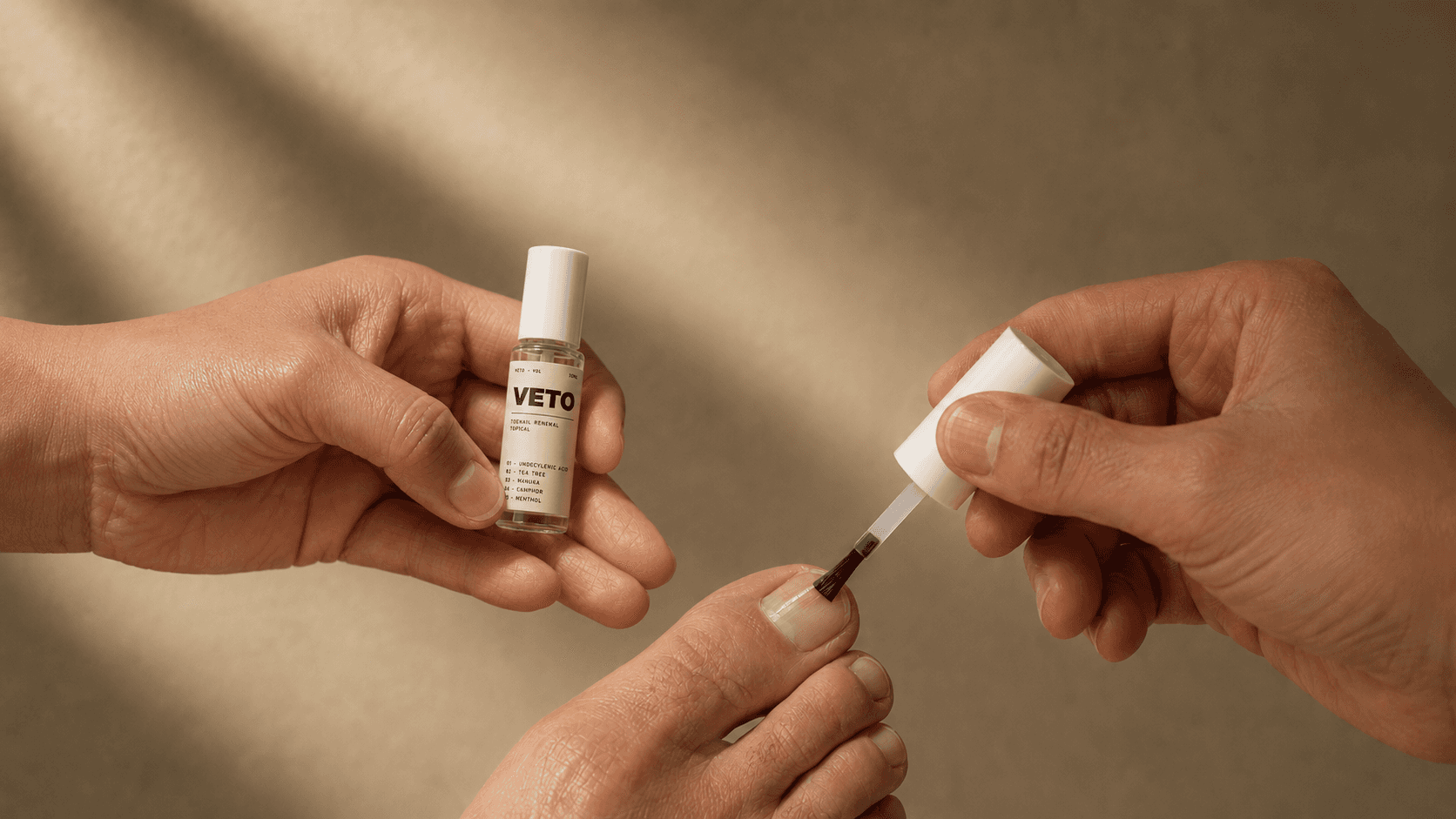
That's the gap Veto sits in. Veto is a cosmetic, regulated the same way moisturizer or hair conditioner is regulated. It doesn't treat fungus and doesn't claim to. What it does is help with the appearance of damaged toenails. Discoloration, brittleness, dryness, the texture of a nail that's been through years of something. It's built for daily long-term use, the way the timeline of nail growth actually requires.
For a nail that's been correctly diagnosed as non-fungal, the conditioning oils help with the visible nail regardless of what damaged it. For a nail that is fungal and is being treated by a doctor, Veto is built for what comes after, the months of grow-out where the visible nail still looks affected even though the underlying fungus is gone. We can't claim it prevents recurrence. We can say it's designed for the timeline, and that daily-use cosmetic care of the visible nail is the kind of routine podiatrists typically recommend post-treatment.
If your goal is to clear the fungus, that's a doctor's project. If your goal is for the nail to look right again, that's a cosmetic's project. The aisle has been selling you the first when most customers actually wanted the second.
The honest version
The honest version of the toenail care category is shorter than the dishonest one, which is part of why it doesn't get told.
Drugstore antifungals are approved to treat the skin around the nail, not the nail itself, and the indication is disclosed in the fine print on the back of every box. Prescription topicals clear the nail at rates between seven and eighteen percent over forty-eight weeks of daily use. The oral prescription is meaningfully more effective and asks you to monitor your liver. Between a third and half of "fungal" toenails are not actually fungal and won't respond to any antifungal at any strength. The home-remedy family has a modest, real evidence base. The visible appearance of a damaged nail can be improved by daily cosmetic care regardless of what caused the damage in the first place.
None of that is in the marketing material. All of it is in the literature.
If you've read this far, you now know more about how the toenail aisle actually works than the people who built it want you to. What you do with that information is up to you. The next twenty dollars you spend on this should probably be a podiatrist visit, not another product. Either way, you'll be making the next decision with the information that the aisle was set up to not give you.
That's the misconception. Now you can stop being part of it.
References
- FDA pivotal trials for over-the-counter and prescription topical antifungals indicated for onychomycosis. Efinaconazole 10% solution: complete cure 15-18% at week 52. Tavaborole 5% solution: 6.5-9.1% at week 52. Ciclopirox 8% lacquer: 5.5-8.5% at week 48. Reported in American Family Physician, 2016, and original FDA approval documentation.
- Wilsmann-Theis D, Sareika F, Bieber T, Schmid-Wendtner MH, Wenzel J. New reasons for histopathological nail-clipping examination in the diagnosis of onychomycosis. Journal of the European Academy of Dermatology and Venereology, 2011. Range of confirmed onychomycosis in clinically suspected cases varies by study from approximately 40% to 60% depending on population and methodology.
- Tang MM, Corti MA, Stirnimann R, et al. Clinical Diagnostic Accuracy of Onychomycosis: A Multispecialty Comparison Study. Dermatology Research and Practice, 2018. 541 toenail clippings from a Brigham and Women's Department of Dermatopathology series, 2000-2013.
- Derby R, Rohal P, Jackson C, Beutler A, Olsen C. Novel treatment of onychomycosis using over-the-counter mentholated ointment: a clinical case series. Journal of the American Board of Family Medicine, 2011;24(1):69-74. 18 patients, 48 weeks of daily application. 83% reported positive treatment effect, 27.8% had mycologic and clinical cure at the end of 48 weeks.
- Indications-for-use language taken from FDA OTC drug monograph 21 CFR 333.310 (Topical Antifungal Drug Products for Over-the-Counter Human Use) and from product labeling currently in market for Lotrimin AF (clotrimazole), Tinactin (tolnaftate), Lamisil AT (terbinafine 1% topical), and Funginail (undecylenic acid 25%).