Most brands in this category use one of three tricks to keep you from understanding what you're rubbing on your toenail. Some bury everything behind the phrase "proprietary blend." Some put one or two ingredients on the front of the box in big letters and the rest in INCI nomenclature you can't decode without a dictionary. Some trademark a "patented technology" with a glossy name and no published data behind it.
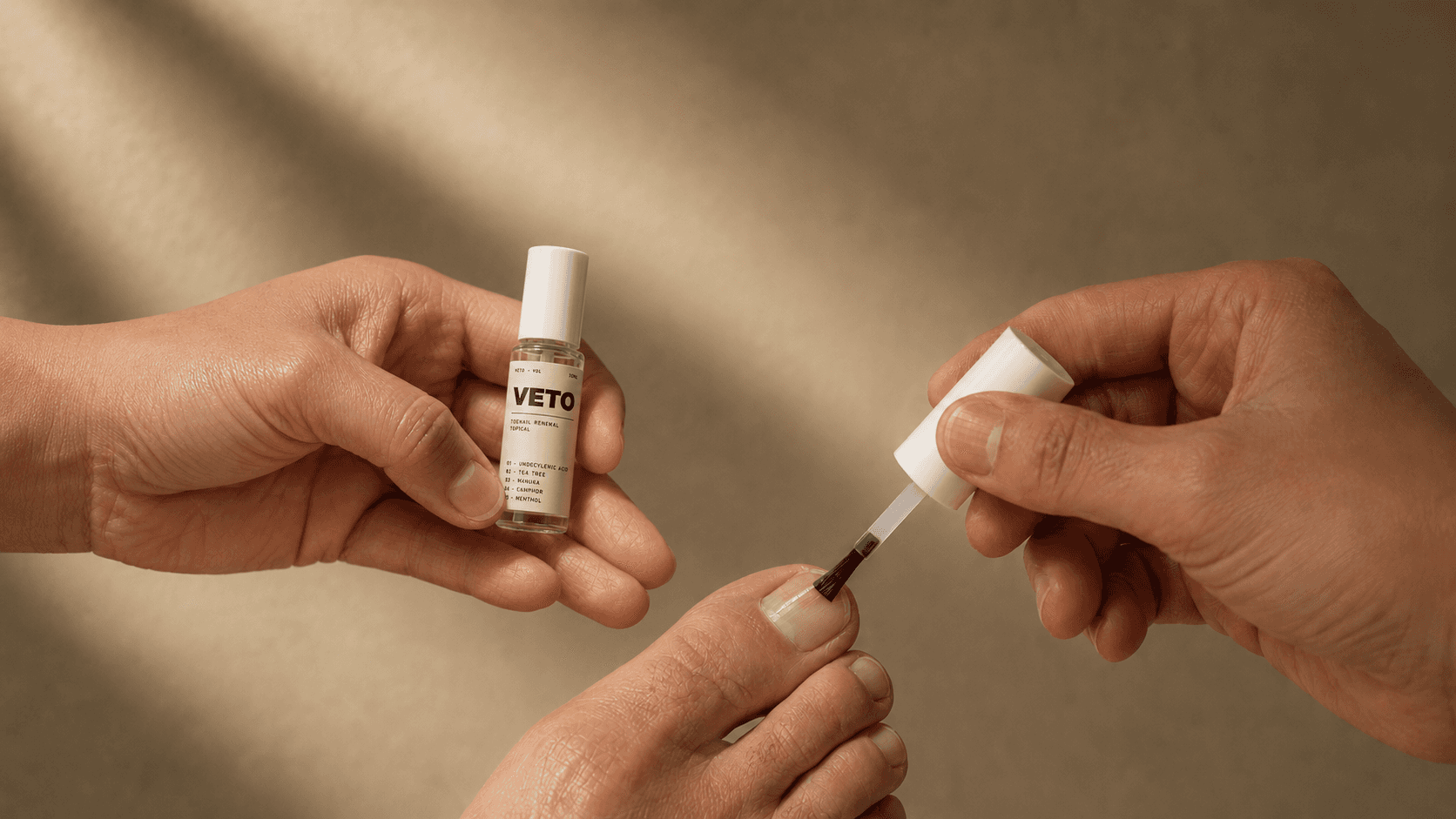
Veto doesn't do any of those things. Every ingredient is named. Every one is here for a reason. Seventeen total. Five do the lead work. Twelve carry, nourish, and round out the formula.
If a brand won't tell you what's in their bottle, ask why.
The five lead ingredients
These are the ingredients the formula is built around. Each one earns its slot for a different reason. Undecylenic acid comes from the pharmacy tradition. Tea tree, manuka, camphor, and menthol come from the family of botanical remedies people have reached for over generations. The formulation pairs the two traditions deliberately, because that pairing is what most products in this category leave out.
Undecylenic acid
From castor oil · Pharmacy use since the 1940sA fatty acid derived from castor oil. It has been used in topical pharmacy formulations since the 1940s, longer than most of what currently sits on a drugstore shelf. The lineage is genuinely old. The reason it's in the Veto formula is the same reason it has been in pharmacy formulations for eighty-plus years: it has a long, stable track record in topical care.
Tea tree oil
Botanical · Generations of topical useThe home remedy you have probably already tried, in some form. Tea tree has been used topically for generations and is one of the most-studied essential oils in dermatology literature. Your instinct to reach for it was reasonable. The question was never whether it had anything to offer; the question was how to put it into a routine you would actually keep. That's the job it does in the Veto formula.
Manuka oil
From New Zealand · Premium botanicalA botanical sourced from the Manuka tree, native to New Zealand. It is the ingredient most formulations in this category skip because it costs significantly more than the alternatives. It is in Veto because the brief was to build the version of this product we wished had existed, not the version optimized for the lowest bill of materials.
Camphor
Medicine-cabinet tradition · Over a century in topical useThe ingredient behind the home remedy your grandmother almost certainly knew about. The mentholated chest rub on the medicine-cabinet shelf has had camphor as a lead ingredient for more than a hundred years. In recent research on toenail care, the camphor-and-menthol family has been the most-studied home-remedy combination. It is in Veto for the same reason: a long history of topical use, and a published track record on this specific use case.
Menthol
Camphor's partner · Medicine-cabinet traditionCamphor's longtime partner. The two ingredients come from the same family and have been used together in topical formulations since long before either of us was paying attention. Menthol is also the source of the cooling sensation you will feel when Veto is first applied. The cooling is real but doesn't tell you much about whether the rest of the formula is doing its work. It just means the menthol arrived.
The twelve supporting ingredients
The five lead ingredients are the headline. The twelve below are what makes the formula a daily-use cosmetic instead of a single-ingredient slap-on. They handle conditioning, absorption, the feel on the nail, and the supporting botanical work. Grouped by the job they do.
These are what make Veto a conditioner. Each one has decades of cosmetic use behind it and a documented role in supporting the appearance and condition of skin and nails.
A note on hydration: oils don't add water in the strict sense. What they do is restore the lipid layer the surface has lost, slow water loss, and support the cuticle and the skin around the nail where new nail growth comes in. The supporting stack below includes aloe vera, which is a humectant and does bind water at the surface. The rest of the work is conditioning. The shorthand most brands use is "hydration," but the dermatology distinction matters: a brittle nail is a nail that has lost its lipid content, not its water content, and the formula is built around restoring the first.
Sweet almond oil
EmollientA long-standing cosmetic emollient. Smooths the surface of the nail and the surrounding skin. Absorbs cleanly without leaving the heavy residue of a petroleum-based ointment.
Jojoba oil
Plant-derived · Skin-compatibleTechnically a liquid wax, structurally the closest plant-derived match to the natural sebum the skin already produces. The reason jojoba is in nearly every elevated DTC skincare product is the same reason it is in Veto: it absorbs into the skin and the cuticle area cleanly rather than sitting on top.
Vitamin E (tocopherol)
AntioxidantAn antioxidant present in the cosmetic toolkit for the better part of a century. In the Veto formula, it conditions the cuticle area, which is where new nail growth comes in. The cuticle being looked after matters because every new millimeter of nail emerges from there.
Walnut oil
Omega-rich conditioning oilHigh in vitamin E and omega fatty acids. Conditions the surface of the nail and surrounding skin. Part of the supporting lipid stack that gives the formula its conditioning weight.
Flax seed oil
Omega-3 conditioning oilOne of the richest plant-derived sources of omega-3 fatty acids. The role it plays in Veto is the same role omega-rich oils play in skincare more broadly: supporting the condition of the surface they are applied to.
Chia seed oil
Omega-rich · Fast-absorbingChia gets used in food for the same reason it gets used in cosmetic care: it is dense with omega fatty acids. In topical use, it is also a relatively "dry" oil, meaning it absorbs faster than heavier alternatives. Part of why Veto feels lighter on the skin than the petroleum-based remedy people have been working around for years.
One ingredient holds the formula in place. It is the reason the conditioning oils above don't simply evaporate off the surface in the first hour after application.
Mineral oil
Occlusive · Decades of cosmetic useAn occlusive, meaning it forms a thin barrier on the surface that slows the rate at which moisture and the other ingredients in the formula evaporate. Mineral oil has been one of the most-used cosmetic occlusives for several decades because it is stable, non-irritating, and well-tolerated. It is the reason a thin layer of Veto continues to do its work for hours after you have applied it, rather than for the first ten minutes.
Two ingredients calm and condition the skin around the nail. The nail itself is what most people are watching. The skin around the nail is where most of the irritation and roughness that comes with damaged toenails actually shows up.
Aloe vera
Botanical · Humectant · SoothingA botanical that has been used in topical care for as long as people have been using botanicals in topical care. The role aloe plays in Veto is two-part: it is a humectant, which means it binds water at the surface and is the ingredient most directly responsible for the small amount of true hydration work the formula does, and it soothes the skin around the nail. The conditioning oils around it slow water loss; aloe is the one that brings water in.
Propolis
Bee-derived · Traditional topical useA resinous compound produced by honey bees. Long-established traditional use in topical skin and nail care. Part of the supporting botanical stack rather than a lead ingredient, but it is on the label because it is in the bottle, and it is in the bottle for a reason.
Three botanicals round out the formula, primarily for their long-standing use in topical formulations and for their contribution to the scent and overall feel.
Clove
Botanical aromaticLong-standing traditional use in topical care. Contributes to the warm botanical character of the formula's scent profile.
Lavender
Botanical aromaticOne of the most-used botanicals in cosmetic formulation, both for its aromatic profile and for its long history in topical use. In Veto it sits in the supporting layer that softens the medicinal character of the lead ingredients into something the bathroom counter doesn't reject.
Lemongrass
Botanical aromaticA botanical with a long traditional history in topical use. Contributes a brighter top note to the scent profile and rounds out the aromatic layer of the formula.
What is not in the bottle
The list of what is not in Veto is almost as deliberate as the list of what is. The choices below are the ones the category is most likely to make differently, and the ones we considered most carefully before making them.
No proprietary blend. No buried language.
- No "proprietary blend." Every ingredient is named on the bottle and named in this post.
- No patented technology with a trademarked name. Nothing in the formula is anything you couldn't, in principle, source the underlying components of yourself.
- No optical brighteners. Products in this category sometimes add these to make the nail look temporarily shinier the moment you apply them. That gloss washes off and is unrelated to anything happening underneath. We chose against it.
- No silica-based gloss agents. Same reason as the optical brighteners. Short-term cosmetic shine doesn't earn a slot in a formula built for the long timeline.
- No oral compounds, no prescription actives, no ingredients that require monitoring. Veto is a topical cosmetic. You don't need bloodwork to use a cosmetic, and we built it that way deliberately.
- No miracle claims. We are not selling you "14 days." Toenails do not grow that fast for any product, including this one.
Why this list exists in this format
Most ingredient pages in this category exist to be skimmed and forgotten. We wrote this one to be read.
The reason we wrote it at this length is that the customer who reads ingredient lists is the customer this brand was built for. The people who have been burned by "proprietary blend" and "patented technology" claims. The people who turn the box around at the pharmacy to read the back. The people who, by the time they got to Veto, had already learned to be skeptical of anyone who didn't show their work.
The seventeen ingredients are the work. The list above is the show.
If you've read this far, you've now seen every ingredient in the bottle, what each one does, and what isn't included. There is no second list. There is no asterisk. The bottle holds these seventeen, and that is the formula.
A note on what this list is not
Veto is a cosmetic. It is regulated in the same category as moisturizer or hair conditioner. It is not a drug, it is not an antifungal, and it is not approved by the FDA to treat any medical condition. The ingredients above do real cosmetic work, conditioning, soothing, supporting the appearance and condition of the nail and surrounding skin, and that is what the formula is designed to do.
If you have a confirmed fungal infection of the nail that you want killed, that is a doctor's project. The prescription oral antifungals are the medical-grade option, and a podiatrist or dermatologist is the person to talk to about them. If you have a damaged toenail and your goal is for it to look right again, that is a different project, and the daily-use cosmetic with the seventeen ingredients above is the kind of product built for it.
The honest version of this category is one we hope more brands will eventually adopt. For now, we'll start by adopting it ourselves.