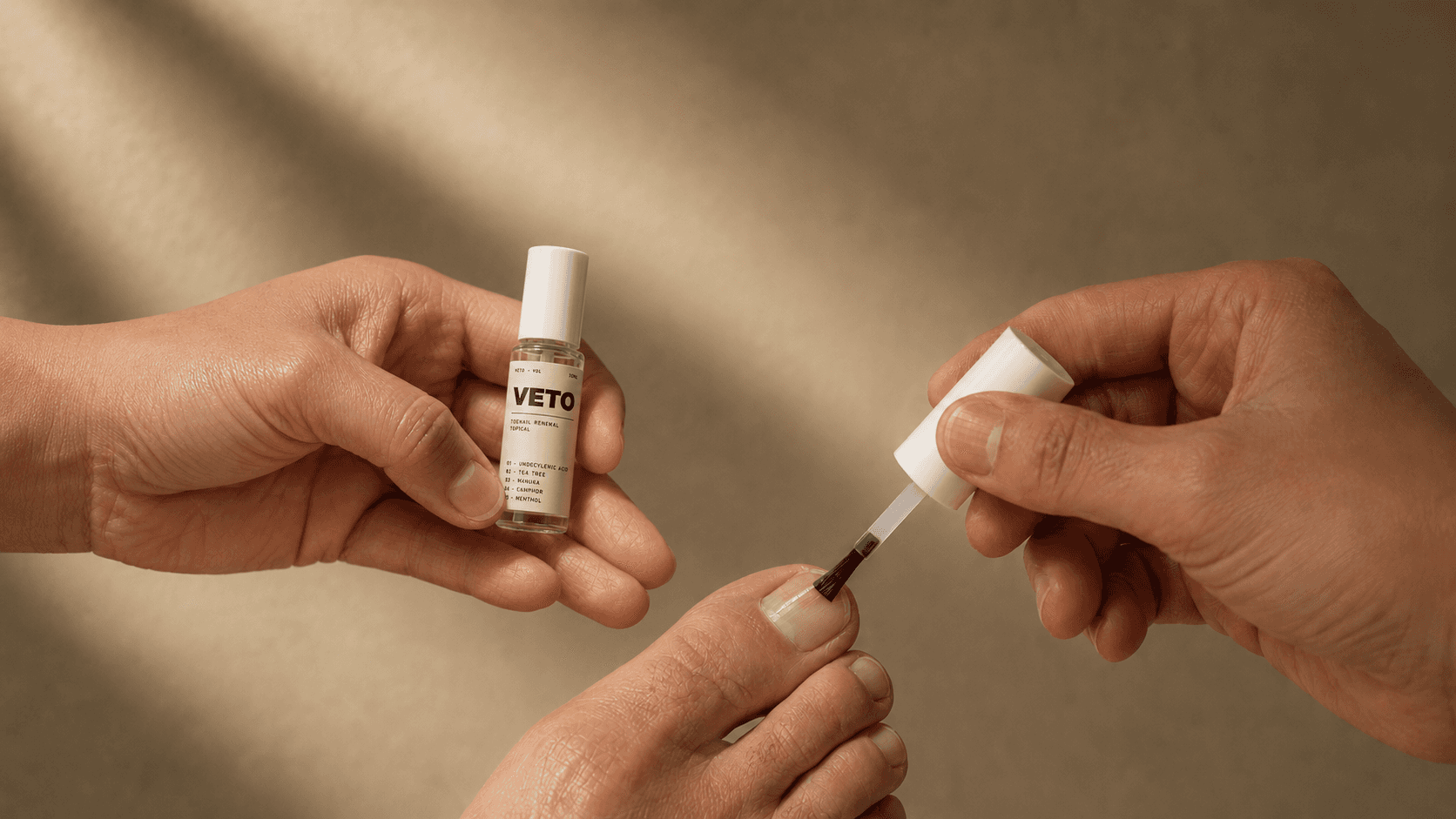
Most products in this category will tell you they're scientifically formulated and leave it there. The "science" is implied by the packaging, by the words "advanced" and "clinical" and "breakthrough," by a trademarked technology name with a registered-symbol superscript. The actual research that's supposed to be underneath any of it goes uncited.
This is the version where the receipts are on the table.
Veto isn't built around a single hero ingredient or a single research paper. It is built around two long-running traditions in topical care, the pairing of which is the thing this category has historically left out. Below is what each tradition has documented behind it, what we know and don't know, and how Veto fits into both.
Two traditions, paired
Every product in the toenail aisle, when you strip the marketing language away, comes from one of two lineages. The pharmacy tradition is what shows up on the prescription pad and the over-the-counter monograph shelf. The medicine-cabinet tradition is what your grandmother knew about, what people have reached for over generations, and what Reddit threads still rediscover every year.
The pharmacy tradition has the regulatory clearance. The medicine-cabinet tradition has the cultural memory. Most products pick a side. Veto's formulation pairs the two on purpose, because the parts of each tradition that work are the parts the other one is missing.
Different lineage. Different evidence base. Veto pairs both.
Undecylenic acid
A fatty acid derived from castor oil. In topical pharmacy formulations since the 1940s. Longer-established than most of what currently sits on a drugstore shelf. Still used in over-the-counter foot-care products today.
Camphor, menthol, tea tree, manuka
Botanical and semi-botanical ingredients with a long topical history and a published, peer-reviewed pilot study on the camphor-and-menthol family applied to toenails specifically.1
What the published research actually says
The most-cited piece of research in this conversation is a pilot study published in the Journal of the American Board of Family Medicine in 2011.1 The trial tested a specific mentholated topical ointment (the kind people had been quietly applying to their toenails for decades) on a group of patients with culture-confirmed onychomycosis. Eighteen patients. Forty-eight weeks. Daily application.
of study participants reported positive effect on their toenails after 48 weeks of daily use of the camphor and menthol family.1
That number, 83%, is the one most people see when this study is referenced. The detail that gets cited less often is the rest of it. Of the eighteen participants, just over a quarter had culture-confirmed mycological cure at the end of the trial, meaning the lab couldn't find fungus on the nail anymore. Just over half had what the researchers called "partial cure," meaning the appearance and the cultures both improved but the cultures weren't fully clean. The remaining participants saw cosmetic improvement without mycological change.
The honest read on that trial is the one the trial's own authors offered: the camphor-and-menthol family showed a meaningful, replicable, clinically observable effect on the appearance and condition of toenails over a long timeline, and a smaller subset of users saw the underlying culture clear as well. It is one pilot study. It is not the whole literature. The findings warrant longer-running, larger-scale trials. What it is enough to say is that the home remedy was never folklore. The chemistry behind it has been there all along.
The 83% figure belongs to the specific topical the study tested, not to Veto. Veto includes camphor and menthol, the active ingredient family the research is on, alongside the rest of the formula. The lineage is real. The results that belong to one specific product remain its own.
What the pharmacy tradition has documented
Undecylenic acid does not have a single landmark study attached to it. What it has is eighty years of continuous topical use, an FDA over-the-counter monograph that has approved it as a topical antifungal for athlete's foot since the original 1972 monograph review, and a place in pharmacy formulations longer than most other ingredients in this category have existed.2
The reason it has stayed in formulations for that long is not because of a recent surge of evidence. It is because no superior replacement has displaced it. Topical pharmacy chemistry on fatty acids of this kind has been understood for decades. The pharmacy tradition trusted it in 1942 and trusts it in 2026.
Veto uses undecylenic acid at cosmetic concentration. The formula is not an over-the-counter antifungal, and the brand is not regulated as a drug. The ingredient is in the formula because the pharmacy lineage is part of what we wanted the formula to inherit. The lineage is what's in the bottle, alongside the medicine-cabinet family. The combination is the point.
Why neither tradition is enough on its own
Both traditions have customers who used them, saw partial results, and gave up. The reasons they gave up are usually not the reasons the marketing material describes. Three things sit underneath most of the failure stories, and the same three things sit underneath the design choices in the Veto formula.
The home remedy was always under-delivered. The mentholated chest rub the 2011 study tested was a thick petroleum-based ointment designed for chest application. People applied it to their toes, wrapped the toes in something to keep it in place, slept in socks to contain the transfer, and woke up to find half of it had moved to the sheets. Most of the abandonment of the home-remedy tradition isn't about the chemistry. It's about a routine that asked you to choose between the remedy and your bedding.
The drugstore aisle was always under-targeted. The over-the-counter products that include undecylenic acid or the topical azoles are mostly approved to treat the skin around the nail, not the nail plate itself. The fine print on the back of nearly every box discloses this. Customers buy them assuming they will treat the visible toenail. The packaging implies what the indication doesn't allow it to promise.3
Neither tradition treats the supporting nail. Both the pharmacy and home-remedy approaches focus on a single active ingredient and ignore the fact that the surrounding nail and skin are also damaged, dry, and in need of conditioning. A nail being looked after week after week is a different surface from a nail that has had something painted on it once a day. Cosmetic conditioning, the kind of work that moisturizers and serums do for the rest of the body, has historically not been part of this category at all.
What Veto does differently
The Veto formula brings the two traditions into the same bottle for the first time, alongside the conditioning stack that turns the active ingredients into a daily-use cosmetic instead of a one-note slap-on. Three design choices specifically.
The pairing. Undecylenic acid, tea tree, manuka, camphor, and menthol are the five lead ingredients. None of them is novel. The combination is, because most products in this category have historically picked a tradition and stayed there. Veto's formula is built around the pairing because the parts of each tradition that worked are the parts the other was missing.
The supporting stack. Twelve more ingredients carry the lead actives. Sweet almond oil, jojoba, vitamin E, walnut oil, flax seed oil, chia seed oil, aloe vera, propolis, mineral oil, lavender, lemongrass, clove. The role of the supporting stack is to make the formula a conditioner, not just a delivery system. The nail you have today is conditioned today; the nail growing in over the next year is also conditioned, every day along the way. A more detailed walk-through of every ingredient is in the full ingredient breakdown post.
The format. A brush-on liquid, not a petroleum-based ointment. The carrier oils spread thinly across and around the nail and absorb in minutes. The brush bristles deliver the formula into the cuticle area where new growth comes in and into the gap between the nail edge and the skin where heavier ointments can't reach. The bandaid-and-sock workaround that the home-remedy generation grew up with is the thing the format is designed to make unnecessary.
The honest limits
This is the part of the science conversation that most brands in this category skip. The same brands that tell you, in fine print, that their products are approved to treat the skin around the nail, are happy to imply they can do anything in big print on the front. The honest version of where the science of Veto sits is shorter and clearer.
Veto is a cosmetic. It is regulated in the same category as moisturizer or hair conditioner. It is not approved by the FDA as a treatment for any medical condition, and we do not claim that it treats, cures, or prevents fungal infection. If you have a confirmed fungal infection of the nail and you want the underlying organism killed, that is a doctor's project, and the prescription oral antifungals are the medical-grade option. We say the same thing on the homepage. We say it again here.
What Veto is designed to do is improve the appearance, texture, and condition of damaged, discolored, brittle nails. The seventeen-ingredient formula does that through cosmetic conditioning, supported by the lineage and the published research on the lead ingredient families. The pacing of the visible change is the pacing of nail growth, which is roughly one millimeter per month, which means visible early changes are typically reported in the 2-8 week range and a full grow-out from the cuticle to the tip takes 6-12 months or longer.4
None of those numbers are aspirational. They are what biology does. Anyone in this category promising you a different timeline is either describing a temporary cosmetic gloss or selling you something the chemistry doesn't support.
The science behind Veto is the science behind two long-running traditions, paired in a single formula, supported by a conditioning stack that turns the lead actives into a daily-use cosmetic. The research is what's published. The lineage is what's documented. The honest limits are what we'll tell you up front. The rest is what twelve months of daily use will tell you on your own toes.
If you want to see the receipts
This post is the framework. The full ingredient walk-through, every name, every role, what is and isn't in the bottle, lives in the companion post: every ingredient in Veto, named and explained. If you read labels, that is the post for you.
The science of this category does not need a trademarked technology to be credible. It needs to show its work. We've tried to do that here.
References
- Derby R, Rohal P, Jackson C, Beutler A, Olsen C. Novel treatment of onychomycosis using over-the-counter mentholated ointment: a clinical case series. Journal of the American Board of Family Medicine, 2011;24(1):69-74. Eighteen patients with culture-confirmed onychomycosis treated with daily application over 48 weeks. 83% reported positive effect; 27.8% achieved both mycological and clinical cure; 55.6% achieved partial clearance.
- FDA Over-the-Counter Drug Monograph, Topical Antifungal Drug Products for Over-the-Counter Human Use, 21 CFR 333.310. Undecylenic acid included among approved topical antifungal actives for athlete's foot since original 1972 monograph review.
- Product labeling currently in market for major over-the-counter topical antifungals (Lotrimin AF / clotrimazole, Tinactin / tolnaftate, Lamisil AT topical / terbinafine, Funginail / undecylenic acid). Indication-for-use language generally restricted to the skin around the nail rather than the nail plate itself.
- Multiple sources on nail growth rate after age 40. Toenails grow at approximately 1mm per month in healthy adults, slowing with age. A full grow-out replacement of the visible nail from the cuticle to the tip takes 12-18 months. The 2011 JABFM pilot trial (reference 1) used a 48-week endpoint specifically because shorter trials are biologically inadequate to capture full nail replacement.